Wednesday, May 6, 2020

Ad networks in Digital marketing

Understanding ad networks.

Objectives:
The objectives of ad networks in digital marketing are to :

1.Find websites with advertising space to sell. 
2.Connect website to companies. 

Definition:
Display advertising networks are like a middleman, connecting businesses who want to advertise, with websites with ad space to sell. 

Need of ad networks
contacting the site directly to work out the details can get pretty time consuming. This is where
display advertising networks come in. 

Functions of ad networks
  1. They handle both the buying and the selling of displayads, linking businesses to websites that want to sell advertising space.
  2. Another way to think of it is as a marketplace that brings businesses and websites together, helping manage the transactions. 
Examples of ad networks

  1. Google Display Network or 
  2. Yahoo, 
Process:

  • Step1: offer businesses looking to advertise ad space on websites.
  • Step2:Websites that offer these ad  spaces can become a part of these networks. 
  • Step3: set minimum prices for how much money they expect for showing ads.
  • Step4: business can then bid for the spots it wants throughout all the websites in that network, deciding how much they’re willing to pay. 
  • Step5 :Buyers and sellers are connected every single time pages are loaded, and the ads that win the right to fill the ad spot are shown.
Audience Targeting:

Target specific audiences through two main routes: the topics of the web pages where the ads appear, and general information about the people viewing the content. 

Financial management:
Another thing networks do is handle the money involved. Buying and selling ads happens
every second of every day, and the networks collect money from businesses and pay the
websites that show the ads. 

Data management:
advertising networks collect and share data with businesses.

Data analysis:
  1. Number of times ads are shown, 
  2. Number of times ads clicked on,
  3. Cost of advertising
  4. Tracking of websites

Machine learning for Managers Part-1 Introduction

Introduction to Machine learning for managers


Before we explore the world of machine learning, we need to understand a few basics of Machine learning.
This will bring you in the comfort zone as many managers lack engineering knowledge.

Input:

The raw data required for the analysis. This data may be from survey, observations, or from data sets. 
Marketing: Customers purchased data in a Big bazaar retail out let for a month..
Human Resources: Employees training data for last ten years.
Finance: Stock price of FMCG products in last five years on a daily basis.
Operations: The cost of packaging for multiple orders from multiple customers in the firm for last two years.

Algorithm:

Machine learning field works on the algorithms to identify the predicted value. Thus, it is necessary for us to know basics of algorithms. These are set of rules a manager introduces to get the forecast value.
Let us understand with some examples;

Marketing: 

A manager would like to know the best sales promotion tool for his online marketing campaign in different markets. The set of rules are as follows:
Step1; START
Step2; Define promotional too used by a company Search ads, display ads,
Step 3; Define different markets: Panaji, Mumbai, Bengaluru, Delhi, and Chennai.
Step4; Define revnue from diffrent markets.
Step 5: Define cost of promotion types in different markets.
Step 6; Calculate Revenue per market per campaign.
Step 7: Calculate the best ROI for a promotion on a market wise
Step 8; STOP.

Human  Resource Management:

A human resource manager would like to know influence of educational qualification in completing a particular project. This will help them in recruiting a better candidate next time. The rules can be;
Step1: START
Step 2: Extract the education qualification data from employee records say CS, IS, Mechanical, Civil etc...
Step 3; Collect project time taken by each employee.
Step 4: Identify the project difficulty level easy, medium and difficult.
Step 5: identify the best combination of difficulty, qualification and optimum time.
Step 6: STOP.

Finance:

A finance manager want to construct a portfolio of stocks to recommend his clients. The algorithm can be set as below:
Step 1; START
Step 2 : Collect P/E ratio of all NSE stocks and set range of expectation.
Step 3: Collect EPS data for all NSE stocks
Step 4: Collect dividend announced by companies in last five years.
Step5: Define sector names ( Automobile, Bank, IT etc..0
Step 6: Calculate top 10 companies a sector wise on P/E, EPS and Dividend.
Step 7; Collect predicted growth rate for each sector.
Step 8; Divide company in Step 6 based on STEP 7 paramter.
Step 9; STOP


Monday, May 4, 2020

GATI case study: Shipment delivery excellence


Supply chain challenges and issues in covid 19 Corona days- The Indian perspectives


Covid-19 Corona virus has bought business to standstill. The world economy suffered irreversible consequences due to this epidemic outbreak. It has affected hungry need of millions across the globe and notwithstanding many more lost the job for life time. This unprecedented scenario has exerted pressure on supply chain sector. This article discusses supply chain challenges and issues emerged during and after covid-19 Corona days.
According to economic times ( corona virus supply chain shock03/004/2020) , the virus outbreak has hit badly to auto component industry due to their reliance on Europe and US market.
The Hindu business line in its article on 01/04/2020 had written in length about the Indian supply chain vulnerabilities. Highlights of the article are emerging cost minimization models and just in time delivery. Further, supply chain risk of china sourcing exposed in this lockdown period. Added to this, renewable energy sector, pharmaceutical sector and auto-components buy large quantity of components from china are wandering for not finding the future path. Apart from this article stressed on Indian firms inability for quick response and resilience. Now, more number of firms believes in de-risking the business from hugely depending on single source strategy. However, these risk propositions have provided a window of opportunity for local Indian companies.
Umashankar Mishra’s article on Agriculture supply chain during lockdown written the positive gain to agriculture sector. The article lauded Indian council of agricultural research (ICAR) effort in developing an app that connects farmers and freight management system. The app emerged as the platform for both farmers and middlemen to fix their pricing issues. Further, the article emphasized on connectivity of farmers and app to reduce logistics hassles in the supply chain.
Vishwanath Kulkarni (March 26, 2020), in the Hindu business line, discussed about panic buying affecting inventory at middlemen though government is having huge stocks. In addition to this, the writer penned that logistics roadblocks due to lockdown bought gaps between stock at government and stock at middlemen. Companies like Ninja cart had faced state border issues to procure vegetables and fruits from other states. Another company waycool beloved that it’s not the supply issue but its supply chain issue due to those customers was not receiving products.

Tuesday, April 28, 2020

Digital marketing efforts of Bigbasket.com

Digital marketing efforts of Bigbasket. Com

Introduction to the company

 Big Basket laid foundations in 2011.It is India's largest online grocery store company. The seed of the company sown by Mr. Hari Menon.

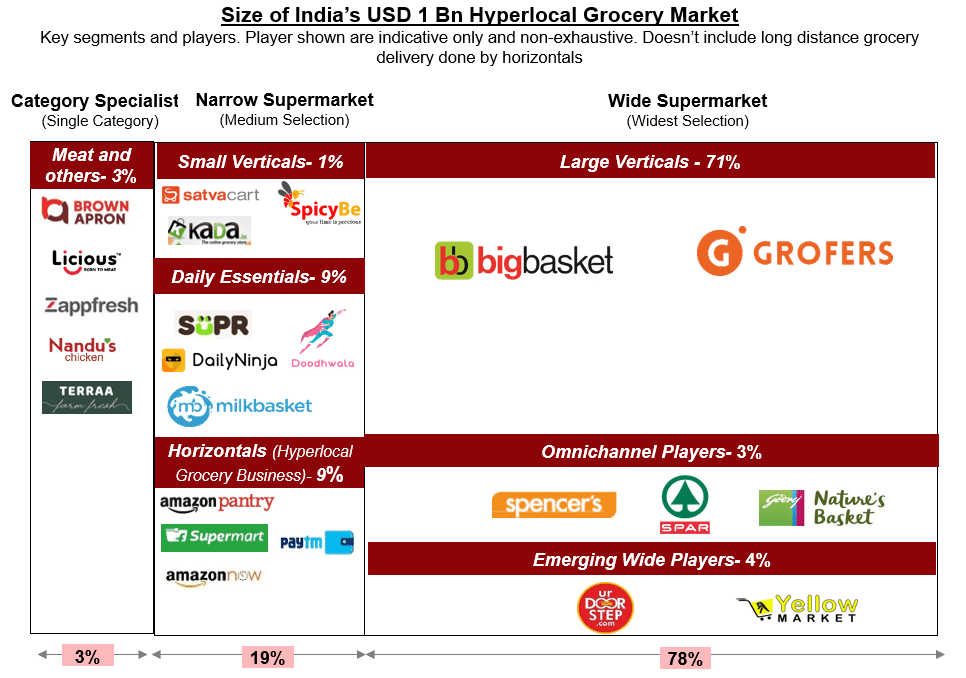
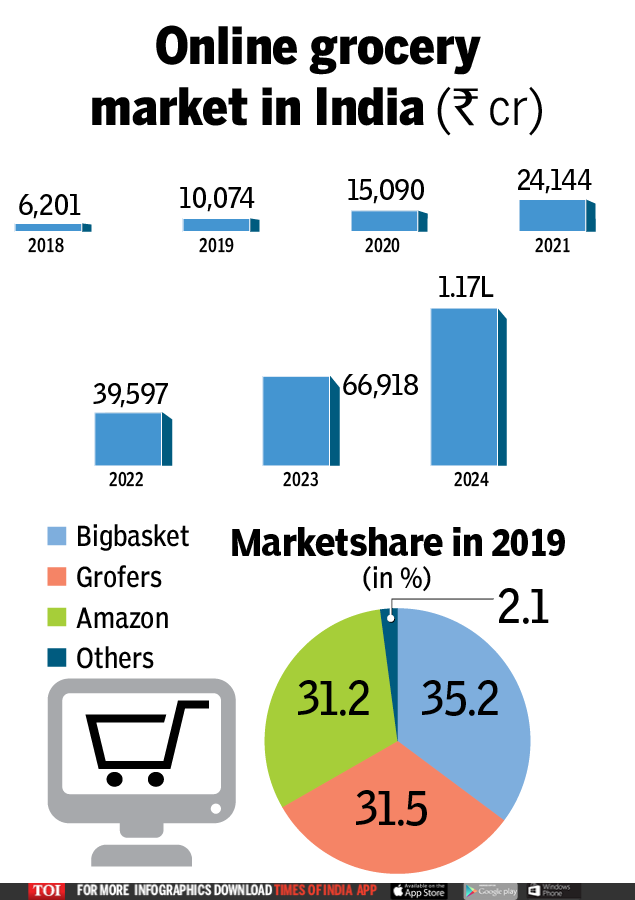
Introduction to online grocery market in India. 

(Source: Redseer.com)
  
(Source: https://static.toiimg.com/photo/imgsize-55724,msid-75426369/75426369.jpg) 


Retargeting

Definition of retargeting

  • Retargeting is the digital marketing technique of attracting customers who viewed about product but didn't buy it
  • Retargeting is the paid advertising method wherein advertisement are positioned in other website after customer didn't proceed for either carting or checkout. 
  • Retargeting are remarketing tools in which advertisemens appear in front of customer from previous search history. 


Where Retargeting works

  • Retargeting works well with mobile applications
  • It fits well with search ads
  • It suits website banner ads

Benefits of Retargeting


  • Increases customer awareness
  • Cost effectiveness
  • Long term campaign
  • Focused targeting
  • Timed targeting
  • Large scale reach
  • Campaign analysis
  • Ad creation using ad gallery
  • Efficient pricing with automated bidding
  • Brand promotion
  • Maximize a customer life time value
  • Increase the conversion rate
  • Higher commitment
  • Increased creativity
  • Pitches for potential customers
  • Increases sales. 
  • Audience selection
  • Point of contact
  • Increased brand recall
  • Increased customer trust
  • Increases relevance of ads
  • Reduces losses


Types of Retargeting

Classification 1


Standardized  Retargeting
Dynamic Retargeting
Remarketing with list of search ads
Video Retargeting
Customer list Retargeting

Classification 2

Consumer personality based targeting
Cross channel Retargeting
Account based Retargeting
Email Retargeting
Customer Retargeting for brand loyalty
Facebook custom audience

Classification 3

Objective based Retargeting
Plan based Retargeting
Engagement based Retargeting
Onsite Retargeting
Video Retargeting

Classification 4

Pixel based Retargeting
Social Retargeting
List based Retargeting
Onsite Retargeting
Search Retargeting

Classification 5

Website Retargeting
Contextual Retargeting


McDonald's franchise case

McDonald's franchise case

Friday, April 24, 2020

Taking payments and managing orders.

 Taking payments and managing orders.
A company joining the e-commerce world has to decide on how they are going to accept the payments online. 
Let's say a grocery e-commerce startup that sells in a small town. 
Strategy1: Use Payment company sites. 
Showcase your products on online and customer cart groceries and also proceed further for payments, the company with payments button take a customer to a third party website like PayPal. 
The advantage of this strategy is a startup need not think about infrastructure, security, and receipts.
Strategy 2: Digital wallets
In this strategy, a customer loads cash into the e wallet of a company through his bank accounts and pay from it to purchase merchandise. 
Strategy 3: Cash on delivery- Cash payments. 
Unlike western world, India is not open to digital payments. Thus, a startup may ask customer to order online and pay cash at the time of delivery. 
Strategy 4 : Cash on delivery - digital payments. 
In this strategy, a customer orders a product online pay using debit card, or credit card or unified payments system( Google pay) 
Strategy 5: Pay in the integrated payments platform using digital payments
A customer orders online and pays in the company e-commerce site using netbanking, credit card, debit card, and third party UPI like Google pay. 
Strategy 6: use bitcoin payments. 
The advent of block chain and bitcoins Encouraging a customer to pay through digital currencies. 
Order management
In this strategy 1, a company focuses on a transaction and don't have control over customer payments. There may be issues of improper financial transactions. 
However, when start up have complete e-commerce platform, apart from payments, it asks customers to create accounts and load personal details. This will aid a company to customize their sales promotion. 
The integrated platform  gets customer shipping addresses, can get permission for their contact sharing, and track orders for better customer satisfaction. Further, it can do market basket analysis and provide products recommendations. 

Tuesday, April 21, 2020

Understanding the data life cycle - PDCA approach

 Understanding the data life cycle
The data cycle improves the decision making of the firm from information collected from different online marketing activities. 

 The four main stages of a data cycle are: Plan, Do, Check and act

Plan:
Let's take an example of a retail store in your neighborhood. They want to communicate their new door delivery facility to consumers. 
The first step is set the goal. The retailer want at least 30℅of their existing customers to avail the benefit in the next one month. 
The retailer would like to run social media campaign for the same. 

Do:

The retailer runs social media campaign for a specified period say a week. 

Check:
After the specified period, the retailer will asess whether he would be able to get 30℅ door delivery orders. They also check weather post on Facebook, Instagram, or Google got a better result. The social media sites those could not get the results needs to be reasessed. 

Act:
In this stage, a retailer will understand shortcomings and run future campaigns with modifications. They may alter timing, content or offering. 

Notes:
Collect data periodically
Use Google Analytics
Find the trends for future endiviours. 

Question: How marriage Hall will use PDCA in their digital campaign?