Showing posts with label Case studies. Show all posts

Thursday, October 13, 2022

JP Morgan Chase's Hadoop system. Has the time arrived to review Big Data analytics infrastructure?


JP Morgan Chase's Hadoop system. Has the time arrived to review Big Data analytics infrastructure?

Dr. Prasad Kulkarni- Consultant- Britts Imperial University Sharjha.


Hadoop


It's an open source platform used to solve big data using a network of computers. It provides a framework for distributed storage and processing of big data using the Mapreduce programming model.  It is built on the principles of framework should handle the common hardware problems.  Hadoop is versatile and can be used for different tasks. More than this Hadoop offers scalability to enterprises.

Hadoop in the financial Sector

Risk Modeling

Financial sector faces the problem of credit risk, market portfolio risk, and operational risks.credit risks are subject to the bankruptcy of debtors whereas market portfolio risks arise due to inverse returns in portfolio returns. Further, operational risks emerge due to failure of organization’s processes[1]. These risks made financial sector enterprises maintain multiple databases. However, for analysis assembly of files into a  single repository is necessary. This resulted in financial sector companies trusting on Hadoop.

Mass customization:

Financial sector is becoming competitive. To be in the forefront, financial services firms are personalizing their offers. A few firms took a step ahead to offer customized products to clients. This mass customization effort coupled with risk analysis required a quality repository that Hadoop can support.


Local data warehouse v/s cloud data warehouse

The year 2008, is the turning point in the financial sector. Till then banks were over protecting their customer data in the local data warehouse. It resulted in the financial crisis as many had no idea about customers other than data submitted to banks. These financial institutions began unearthing the information from emails sent by costumes, their call center conversations, and chat sessions with company representatives. The data produced was enormous for financial services firms. A few of them adopted Hadoop Mapreduce for sentiment analysis, text analysis and behavioral analysis using cloud solutions.

Market predictions

A financial firm has to keep a tab on the stock exchanges how the company and its competitors are performing. It also keeps vigil on regulatory bodies and their change in policies that may affect the firm in the future. The challenge was these data sources were independent and needed integration. Hadoop has worked on integration of these sources to provide more clear insight about the market for financial services firms.

About J.P.Morgan chase

J.P morgan Chase is the largest bank in the USA, headquartered at NewYork city. The bank is named in the Fortune 500 list at the 24th position. It provides investment banking and financial services[2] The former chemical bank merged with Chase Manhattan  corporation in 2000 and was renamed as the J.P. Morgan Chase. JPMorgan's business consists of four main segments: Consumer and Community Banking, Corporate and Investment Banking, Commercial Banking and Asset Management. J.P Morgan Chase built on principles of providing exceptional customer service with integrity and responsibility. J.P.Morgan Chase is a leader in investment banking, financial services for consumers and small business, commercial banking, financial transactions processing and asset management[3].

J.P.Morgan Chase Hadoop system

Credit card information:

J.P.Morgan Chase collects huge data from credit cards of customers. The unstructured data is supported by the Apache Hadoop framework.

Customer service information

The company gets a large number of emails from customers . Though it puts in a relational database but started using an open source framework. It helps the company to do proper risk management[4]

Challenges to Hadoop in 2022.

Emergences of new technologies

Hadoop which was a replacement for relational databases is facing stiff competition from Spark which is internal memory based.  Further, AWS and Microsoft Azure provide cloud based service with faulty tolerant distributed computation at affordable price.

Smile file problem

Hadoop was developed for large files. As we are entering the world of specialized niche software, files may be smaller but Hadoop Mapreduce can not handle data less than 128 MB[5].

Real Time analytics

Hadoop works on batch processing. Hence it is very slow in processing. Developers are mounting Spark on Hadoop systems to get real time analysis[6].

Path ahead for J.P Morgan Chase.

J.P. Morgan Chase  began using Sqrrl, a market app collecte tax saving data, SIP mutual funds and goal based investments for big data analytics. It integrates different datasets and offers data security. The app works on graph analytics to find any outliers in the data security[7].

J.P morgan availed the services of Palantir . This big data analytics software integrates unstructured and structured data to improve the search capabilities. Further, the software helps J.P. morgan chase to to integrate the data and qualitative analytics. This helped the company to identify the  internal fraud in the company[8].

Datawatch another application in big data analytics leveraged by J.P.Morgan Chase to predict market information. It developed on the Data watch platform to keep tabs on real time data arising on the web pertaining to domains of J.P Morgan chase. And offer solutions to the company.

The adoption of niche applications  and emerging trends in Big data technology raised following questions to J.P. Morgan

1.      To continue or not with the Hadoop system for the future?

2.      Is there a necessity for mourning Spark on Hadoop for faster and real time analytics?

3.      Does the company continue to use niche software for specialized functions and create data platforms or look out for third party vendors offering end to end solutions?xctionaclient service; acting with integrity and responsibility; and supporting the growth of our employees.

eliv

References:

1.      Risk Modeling. (2022). Retrieved 11 October 2022, from https://nms.kcl.ac.uk/reimer.kuehn/riskmodeling.html

2.      JPMorgan Chase - Wikipedia. (2022). Retrieved 11 October 2022, from https://en.wikipedia.org/wiki/JPMorgan_Chase

3.      Our Business. (2022). Retrieved 11 October 2022, from https://www.jpmorganchase.com/about/our-business#:~:text=We%20are%20a%20leader%20in,transactions%20processing%20and%20asset%20management.

4.      How JPMorgan uses Hadoop to leverage Big Data Analytics?. (2022). Retrieved 11 October 2022, from https://www.projectpro.io/article/how-jpmorgan-uses-hadoop-to-leverage-big-data-analytics/142

5.      The Good and the Bad of Hadoop Big Data Framework. (2022). Retrieved 11 October 2022, from https://www.altexsoft.com/blog/hadoop-pros-cons/

6.      Chaturvedi, V. (2014). When to and when not to use Hadoop. Retrieved 11 October 2022, from https://www.edureka.co/blog/5-reasons-when-to-use-and-not-to-use-hadoop/

7.      Bajaj, K. (2018). Sqrrl: This free app will solve all investment related confusion. Retrieved 12 October 2022, from https://economictimes.indiatimes.com/magazines/panache/sqrrl-this-free-app-will-solve-all-investment-related-confusion/articleshow/62862969.cms?from=mdr

8.      Top 6 Big Data and Business Analytics Companies to Work For in 2022. (2022). Retrieved 12 October 2022, from https://www.projectpro.io/article/top-6-big-data-and-business-analytics-companies-to-work-for-in-2015/107


Saturday, October 1, 2022

A case study on Tesla shared autonomous cars: Challenges of Artificial intelligence in Robotaxis.

 A case study on 

Tesla shared autonomous cars: Challenges of Artificial intelligence in Robotaxis.

Dr. Prasad Kulkarni, Consultant, Britts Imperial University, Sharjah. 01/10/2022


  • Tesla history

  • Artificial Intelligence in Tesla cars

  • Autopilot, Hydranet, Pytorch, Dual Ai chips, crowdsourcing, imitation learning and tracking systems.

  • Overview of robotaxis and Tesla’s  robotaxis

  • Current challenges of Tesla Robotaxi


On 30 September 2022, Mr. Elon Musk, a legendary CEO of Tesla, was in his Austin, Texas office meeting with senior executives of the company. He  was excited about the big announcement for Tesla AI day. These include humanoid , Teslabot, self-driving cars and DoJo Ai chips. However, the criticism from the public for not adhering to the announcement dates was in his mind. The competition arena is also heating up as rivals Waymo and Cruise got licenses to operate robotaxis in a few states of the USA. There are glitches found in computer vision technology used by Tesla. Thus it put the company in ambiguity to use fully computer vision or couple with LIDAR. Hardware sharing and understanding the driver behavior raised the privacy issues. However, the company is committed to offer Fully Self Driving(FSD) cars commercially in the selected areas of the USA.

About Tesla:


Tesla is the market leader in electric vehicles and clean energy products. Its market capitalization has reached a staggering $840 billion in 2021. As a result, Tesla has become one of the most valuable global automobile conglomerates. It acquired 21% of the global battery electric market and 14% of the plug-in market. Tesla has supplied a massive number of battery energy storage systems, touching 4 gigawatt hours(GWh) in 2021.  The saga of Tesla's development is interesting. It was incorporated in July 2003 by Martin Eberhard and Marc Tarpenning . The company is named after the inventor, Nikola Tesla. However, the company re-engineered its image after Mr. Elon Musk took over as CEO in 2008. The major objective of Tesla is to provide sustainable transport and energy. 

Artificial intelligence in Tesla

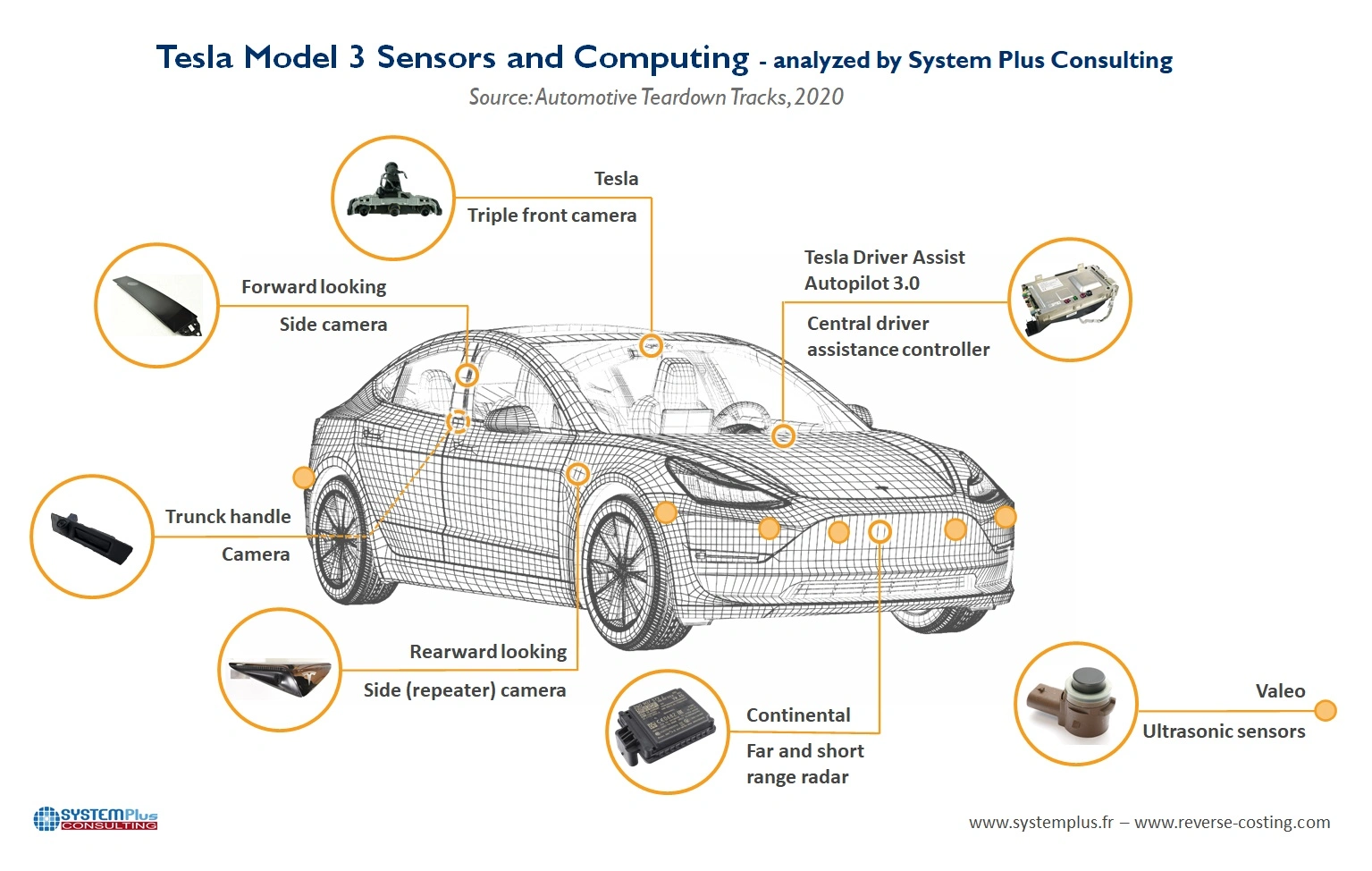
Figure 1: Tesla Model 3 sensors and computing.

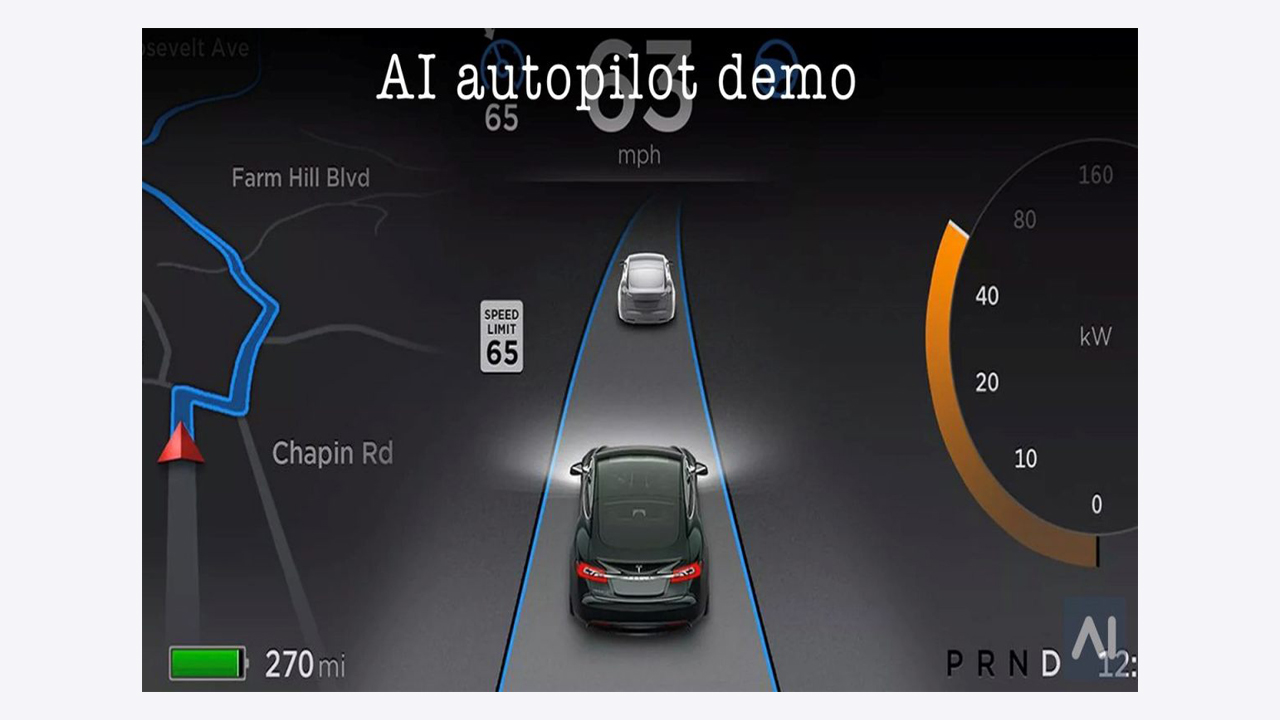
Autopilot

Elon Musk first announced the Autopilot project in 2013. A year later, in 2014, Tesla offered customers the opportunity to pre purchase the Autopilot in association with Mobileye. 

Figure 2: AI autopilot Demo

The Autopilot project was developed on deep neural networks. It consists of sensors, radars, and cameras. For any automobile manufacturer, driver safety is the foremost requirement , and Tesla is no different. It uses ultrasonic sensors to detect moving and stationary objects. Furthermore, it identifies the proximity of the object.  

Tesla cars widely used computer vision technology. Tesla cars have rearward-looking side cameras, trunk handle cameras, forward-looking cameras, and triple front cameras. These captured videos were passed through machine learning algorithms. Further, the data uses convolution neural networks for object tracking and detection.

Radars are important for detecting nearby vehicles and objects to avoid possible collisions. These radars are tested in different weather conditions to ensure error free services. 

Hydranet:

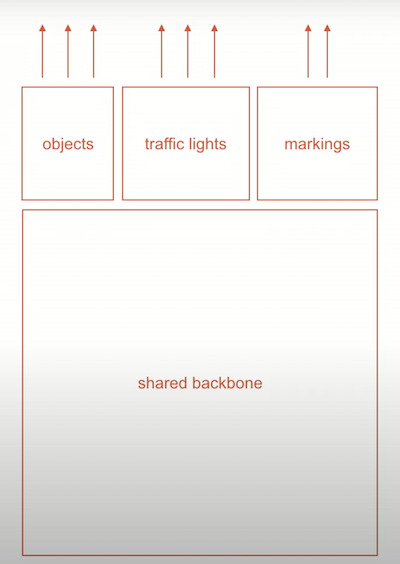
Tesla is a pioneer in using neural networks. However, neural networks become expensive when a vehicle is stationary. Hence, Tesla ran the computer vision processes on the ResNet-50 shared backbone. This neural network shared backbone is known as Hydranet. The information processed on the hydranet is recurrent. The traffic signal images, pedestrian images, or lane changing images are recurrent . These instances required a few parts of the neural network. 

Figure 3: Hydranet architecture

(Source: fireblaze aischool)

Hydranets perform the following functions: road markings, traffic signal management, pedestrian crossings, number of pedestrians, overhead signs, neighboring vehicles, static objects, and environmental tags. Tesla has 8 sensors/cameras to support hydranet. There are eight hydranets performing the eight different tasks mentioned above. 

Pytorch:

Facebook's AI research lab (FAIR) popularized Pytorch.  Tesla's computer vision neural networks were trained on Pytorch. Unlike competitors, Tesla doesn't use LIDAR and purely relies on computer vision. The Pytorch tasks include: workflow scheduling, calibration of model threshold, simulations, and passive tasks. 

Dual AI chips:

The electric vehicle industry is in a nascent stage. In such industries, experimentation is a common task. However, commuters' safety is also paramount to Tesla. This has exerted pressure on Tesla to use two AI chips. In the event of one chip failure, the other chip continues to work. This ensures a smooth ride for Tesla cars for commuters. To support the mesmerizing journey, the AI chip of Tesla comprises 6 billion transistors. These chips with 32 MB of static RAM(SRAM) memory are faster and cheaper than competitors. Hence, collecting data by Tesla is faster compared to Dynamic RAM(DRAM). 

Crowdsourcing and imitation learning:

Tesla vehicles run across the world. These vehicle sensors send an enormous amount of data to the company. So Tesla could understand the driver's behavior and situations in which the data is generated. This artificial intelligence-based study helped Tesla algorithms learn the machine and driver behavior patterns. This type of learning is popularly termed as "imitative learning'' in Tesla. 

Tracking system:

Tesla is way ahead of competitors in technology implementation. The company stores the incorrect data arising from vehicles to train the neural networks. Thus, ensuring future models do not exhibit this behavior. It also tracks driver behavior in the transit. If the driver is idle for a long time, a message is delivered to alert the driver. 

Robotaxi:

These are driverless taxis operated by ridesharing companies. These cars developed on electric vehicle technology opening a new branch of study called transportation as a service(TaaS). Baidu announced the radio taxii cars will be available for $77000. This brings the hope of scalability. Another notable company Waymo expects the hardware cost to go at $ 0.30 per mile. Currently, robotaxi service providers are testing the car in geo fencing areas. These areas are labeled as Objective Design domain(ODD) in the robotaxi industry. Waymo and cruise got a license to run their radio taxi in the California state of the USA. Similarly, Baidu and pony.ai got licenses to run radio taxis in China. The maiden trial was tested in April 2016 by MIT in collaboration with Nutonomy. They worked on Renault Zoes to get initial responses. The encouraging results made Grab a southeast Asia car sharing company to have tie up with Nutonomy. 2017 turned out to be the major year for robotaxi industry. In March 2017 Uber tested robotaxis in Pittsburg and waymo began testing its taxis in phoenix Arizona. The same year cruise announced radio taxi service for its employees. In February 2021, Waymo invited the public to apply to test the radio taxi service in the limited areas with its engineers assisting the car. In february 2022, cruise opened up Robotaxi service in california for the public. 

Tesla’s  Robotaxi

The Tesla learning curve in electric vehicles and autonomous vehicles has helped it to implement Robotaxi. Unlike its Chinese and American counterparts, Tesla allowed drivers to learn to drive the vehicle from the beginning. The decision was an outcome of different road conditions and safety requirements. 

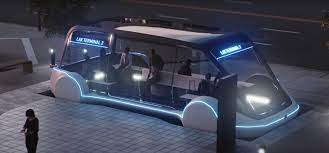
In April 2022, Elon Musk announced that the company was building a futuristic vehicle for the robo taxi industry. The car will be built on full Self Driving( FSD) and won't have a steering wheel or pedal. Further, the company work on the principle of cost per mile should be optimum

Figure 4: Proposed model of Tesla Robotaxi

The Tesla robo taxi will be unveiled in 2023 and its mass production will begin in 2024. The car has an office like structure wherein a customer can start working as soon as he gets into the car. The taxi also has ample space for customers to sleep. Elon musk in his recent interview during the opening of the Austin factory in April 2022 said” “With respect to full self-driving, of any technology development I’ve been involved in, I’ve never really seen more false dawns or where it seems like we’re going to break through, but we don’t, as I’ve seen in full self-driving. Ultimately, what it comes down to is that to sell full self-driving, you actually have to solve real-world artificial intelligence, which nobody has solved. The whole road system is made for biological neural nets and eyes. And so actually, when you think about it, in order to solve driving, we have to solve neural nets and cameras to a degree of capability that is on par with, or really exceeds humans. And I think we will achieve that this year.” It was evident from the speech that computer vision and neural networks have a significant role to play. 

Tesla Robotaxi may be used for rental services in the future. The car can be used as mobile suites in travel and there was evidence from China wherein this concept was implemented. More than this, charging Tesla cars is cheaper than using gasoline based cars. In an interesting description Elon Musk pointed out that Tesla car owners use their cars for 12 hours in the week. Another 20-25 hours in a week customers can rent out Tesla cars for Robotaxi and earn extra revenue.

Tesla Cars currently working on Level 2 certifications as they require driver assistance. The company has to achieve Level 5 to get the license from the USA authorities to run robo taxis. 

Challenges

Energy consumption

The energy consumption of the redistribution of empty vehicles is a critical challenge for autonomous taxis. Waymo, an early entrant in the robo taxi industry, had only 8% occupancy in California. For the remaining time , the taxi was loitering and consuming more energy. 

Unresolved and dangerous technical problems

Robotaxis are expected to reduce traffic problems and bring down the cost of commuting. However, the Cruise in San Francisco caused traffic problems by not detecting the congestion and traffic lights properly. 

Hardware and design issues

Elon Musk's plan of Radio Taxi suffers from two serious limitations. First, it uses very old hardware in their existing system, and second, it doesn't have space for LIDAR. The roof in Tesla's robotic taxi is made transparent. If Tesla wishes to use LIDAR, it should change its hardware and software. Tesla can not launch robotaxis from existing cars as computer vision technology alone is not enough to run fully self-driving cars.

AI mapping

Tesla may train its Dojo chips to capture the data using deep learning.  However, the system may make mistakes when collecting useless data. For instance, a driving car might collect animals nearby that are not required by the autonomous car systems..

Neural network modeling

The Tesla artificial intelligence system has become a hard problem for the company. The company generates a lot of data but is unable to identify the training data a few times. Another issue that popped up in Tesla was the need to define the neural network parameters to test the efficiency of the system. Though Tesla worked on multitasking feature sharing and task decoupling, the problem is still unsolved. 

Conclusion:

Robotaxi will prosper all over the world. The accenture survey of robotaxis had 49% customer acceptance. However, there are two contradictory concepts evolving namely computer vision based and Hardware LIDAR based. Tesla working on fully computer vision based technology is lacking behind in achieving the FSD readiness like Waymo and Cruise. AI is evolving and needs time for Robo taxi companies to provide complete FSD services. On the flipside, human privacy and car hardware compromise may raise serious issues in the future. 

References.

  1. How Tesla uses AI and CV - Blogs | Fireblaze AI School. (2021). Retrieved 30 September 2022, from https://www.fireblazeaischool.in/blogs/how-tesla-uses-ai-and-cv/#:~:text=3.-,AI%20Chip%20%E2%80%93%20Dual%20Chip%20System,work%20through%20the%20spare%20units.

  2. Marr, B. (2021). How Tesla Is Using Artificial Intelligence to Create The Autonomous Cars Of The Future | Bernard Marr. Retrieved 30 September 2022, from https://bernardmarr.com/how-tesla-is-using-artificial-intelligence-to-create-the-autonomous-cars-of-the-future/

  3. Lanctot, R. (2022). What’s Wrong with Robotaxis? - Semiwiki. Retrieved 30 September 2022, from https://semiwiki.com/automotive/316123-whats-wrong-with-robotaxis/

  4. Alvarez, S. (2022). Tesla formally lists Robotaxi as part of vehicles "in development." Retrieved 30 September 2022, from https://www.teslarati.com/tesla-robotaxi-in-development/#:~:text=More%20comments%20about%20the%20upcoming,steering%20wheels%20or%20pedals%20anymore.

  5. Aguirre, J. (2022). Everything we know about the Tesla Robotaxi. Retrieved 30 September 2022, from https://www.notateslaapp.com/news/755/everything-we-know-about-the-tesla-robotaxi

  6. Templeton, B. (2022). Tesla Teases A Custom Robotaxi, Are They Crazy?. Retrieved 30 September 2022, from https://www.forbes.com/sites/bradtempleton/2022/04/21/tesla-teases-a-custom-robotaxi-are-they-crazy/?sh=53af9aa65eb5

  7. Greene, T. (2021). Neuralink and Tesla have an AI problem that Elon’s money can’t solve. Retrieved 30 September 2022, from https://thenextweb.com/news/neuralink-tesla-have-an-ai-problem-elons-money-cant-solve

  8. Robotaxi - Wikipedia. (2021). Retrieved 1 October 2022, from https://en.wikipedia.org/wiki/Robotaxi

  9. Merano, M. (2022). Tesla Robotaxi to shake up rideshare and hospitality industry: Opinion. Retrieved 1 October 2022, from https://www.teslarati.com/tesla-robotaxi-uber-airbnb/

  10. 2024, E. (2022). Elon Musk Makes Fresh Claim about Tesla Robotaxi, Saying Production to Start by 2024. Retrieved 1 October 2022, from https://www.caranddriver.com/news/a39785992/elon-musk-tesla-robotaxi-2024/

  11. Desk, H. (2022). Tesla’s robotaxi will be like Uber and Airbnb combined, hints Elon Musk. Retrieved 1 October 2022, from https://auto.hindustantimes.com/auto/electric-vehicles/teslas-robotaxi-will-be-like-uber-and-airbnb-combined-hints-elon-musk-41659927966965.html


Thursday, September 10, 2020

Case study: Reliance Jio and Facebook deal: A death bell to competitors?


Reliance Jio  and Facebook deal: A death bell to competitors? 

 On April 17 2020, Reliance head office is in a celebration mood when Mr. Mukesh Ambani announced the plan of Facebook buying 9.96% largest minority stake in Jio for Rs 43, s74 crores. This was the largest investment in the It sector in India. The entire deal is cash based. 

Jio Platforms

Jio platforms is the part of Indian conglomerate reliance industry. It started offering services in 2019. During this time $15 billion debt of Jio Platform to the reliance industry to have control over the Jio Platform.  In march 2020 Silver like and Mubadala invested money in the jio platforms. In june 2020 PIF and Intel also acquired a minority stake in the Reliance Jio platforms. Google acquired 7.7% of stake in teh Jio Platforms. 

Jio platform is the parent body of Jio phones, jio mart, Jio Cinema, and  Jio saavn. The deal will give an observer role  and Board seat on Jio  platform to Facebook. Jio Mobiles is having reach of 38 crore people in India

Jio apps included MyJio, JioTV, live TV streaming app, launched on 5 September 2016,  JioCinema, video-on-demand app, JioSaavn, an online music streaming service, JioChat, messaging app, JioMeet, video-conferencing platform, JioBrowser, web browser, JioSwitch, file sharing app, JioNews, newspaper and magazine app, JioHome, mobile remote control for Jio set-top box, JioGate, apartment security app, JioCloud, cloud storage services, JioSecurity, security app, JioHealthHub, health companion, JioPOS Lite, Jio recharge commission earning app, JioGameslite, online gaming, JioMoney, digital currency and payments services and JioMart, online grocery delivery services. Jio valuation has touched 5.5 trillion dollars in May 2020 making it the largest business houses of reliance industries. 

Jio Telecom Performance

( Source: Company annual reports)

Reliance retail

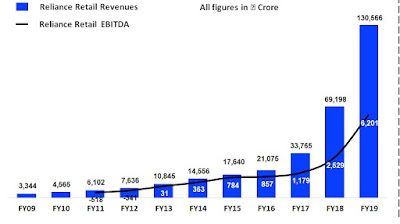
Reliance  retail is the sixth largest retailer in the world. The retail company added 10 stores every day in the last two years and it has 10000 stores. The company has more stores than any other competitor in india. The company has seen 5 crore Indians visiting its stores in 2019 and registered a mind blowing 44% growth. The reliance retail physical presence is now expanded to 6700 cities in india. This resulted in a huge employment generation. In 2020 the company employed 1,13,000 employees. Further the company revenue touched 1,30,566 crores in 2018-19 fiscal year. 

Jio Telecom Revenues

(Source: Reliance annual reports)

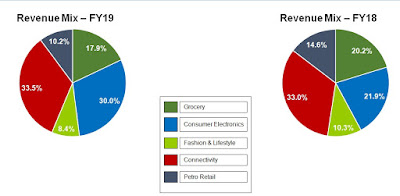
The reliance retail company revenue comes from five different categories. The connectivity(33%) is the largest contributor to the revenue followed by consumer electronics(30%), Grocery(17%), Petro retail(10%) and fashion (8%)

Jio Revenue Mix

Facebook and WhatsApp


Facebook idea generated when Mark Zukerberg was studying at Harvard University in 2003. The earlier name of Facebook was facemash. This site attracted 450 visitors  and 22000 photoviews in the first 4 hours of the launch. Harvard University expelled Mark zukerberg for the violation of privacy data breach.   After finishing the expulsion, Zukerberg convinced Harvard university to come out with a digital version of student directory and launched The facebook site.

In 2004 the company moved its headquarters to california.  Further, in May 2006 facebook was open for public view. The year 2007 gave impetus for the growth of facebook where Microsoft invested in facebook and facebook developer platform started. Facebook saw exponential growth and could achieve 500 million visitors by 2010. The year 2013 turned facebook into the search world. It launched facebook graph search. Unlike earlier versions wherein a customer used to get search links, The facebook graph search gave precise answers.The growth of facebook also led to false message proliferation. In 2015 the company came out with a Facebook algorithm that detects Fake messages. Facebook faced the backlash when major advertising companies like Adidas, Coca-cola , Ford etc.. backed out of Facebook advertisements for not acting hatred messages. 

WhatsApp started by Brian Action, former employee of Yahoo in 2019. The app became a buzzword on the Apple store and the same vibes continued on Google Play store. By 2010 the company crossed the 200 million subscriber mark. In 2014 facebook acquired WhatsApp for a whopping US $19 billion. The year 2016 made WhatsApp absolutely free for the consumption from changing $1 subscription mode. 

Facebook is having 33 crore Indian subscribers making this as the largest market for the company. Similarly WhatsApp is having 400 million customers in India. 


Indian telecom Sector:

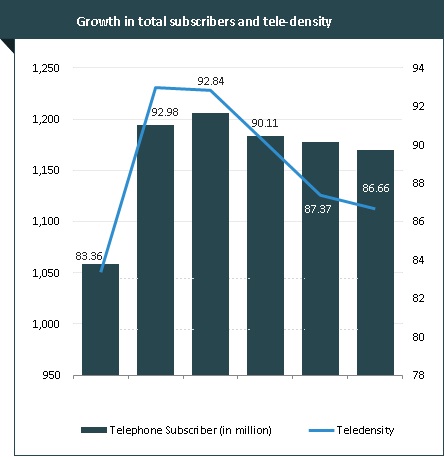
The Indian telecom industry is the second largest telecom sector in the world. India today has 117 crore telecom subscribers and 67 crore internet users. Teledensity in India grew to 87%. India’s data usage over the period grew exponentially. Today, every indian consumes 9GB of data per month. This made India as the country of largest data users in the world. 

(Source: IBEF.org)

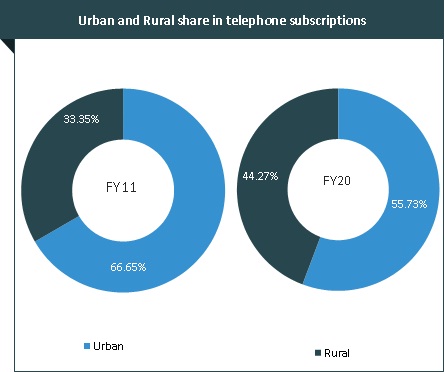
The Indian rural consumers using telephone service grew exponentially. In 2011 the rural contribution was at 33% and it grew up to 44% in 2020. 

(Source: IBEF)

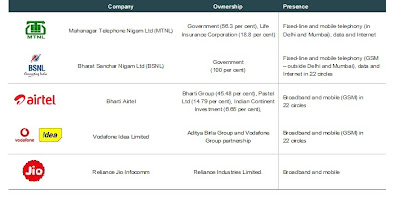
This sector is expected to grow further with the IoT industry emerging faster. The 5G technology may increase data usage and companies will get better revenue in the future.  The Indian telecom competitive landscape is given below: 

Telecom competitors landscape

(Source; IBEF India)


Indian Retail sector

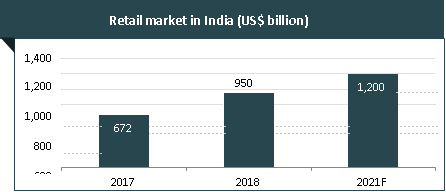
India’s retail market is one of the fastest growing retail markets in the world. It is expected to touch $1200 billion market size by 2021. 

(Source: IBEF)

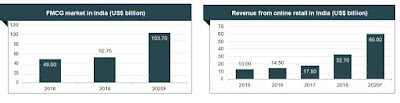
The fast moving consumer goods and online consumer market in India witnessing a healthy growth

FMCG and online retail market in India

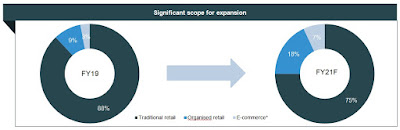
FMCG business is expected to reach US$ 103 billion  by 2020 and Online retail business is expected to reach US$ 60 billion in the same year.  However,India’s organized retail market is in a nascent stage. The organized retail contributes to 9% of the total market. 88% of the market is in the unorganized sector that reliance group and Facebook both are eyeing for their pie. 

India's Organized v/s Unorganized retail 2020

Cross leveraging

Jio Mart and Whatsapp will cross leverage their ecommerce platform to grow their businesses. 

The deal will help many small businesses to sell their merchandise on JioMart using WhatsApp.The deal is having the target of reaching 6 crore SMEs, 12 crore farmers, 3 crore small retailers. Online grocery demand was 1% of 80000 crore rupees market before the lockdown and during the covid-19 lockdown it surged to 50%. JioMart competitors' Bigbasket business has seen tremendous demand in the lockdown but they lacked agricultural resources to supply.  This facebook and Jio deal is expected to provide technology platform for small kirana stores. Further , initially the deal was thought to have obstacles from the competition commission of India. However, the commission  allowed Jio platforms and Facebook to run their businesses on June 24th 2020.  Apart from this, the deal will help Facebook  aggressively push their WhatsApp pay through Jio platforms.  In addition to this, the agreement will open the way for cryptocurrency and block chain technology of Facebook in the Indian market. The government of India allowed block chain technology. It will strengthen the facebook global business. Another plus point of this consensus between Jio and facebook is use of Augmented reality. Facebook augmented reality division Oculus will leverage its technology to Jio Ar. This is expected to redefine marketing communications. One more unnoticed thing in this agreement is advertisement sharing. Facebook ad space can be leveraged by Jio Mobile. This will redefine mobile advertising and marketing in india. The new friendship will open the doors for developing a super app like ‘we chat’ where the customer starts the day with newspaper , meetings , payments,and sports. Finally, this deal will open new vistas for indian gaming industry. Facebook can come out with games like farmville to the indian market. 

Jio Mart and whatsapp  business Model


Jio mart and WhatsApp Business Model

The business model of WhatsApp and Jio Mart is simple and enriching. The Jio Mart provides training to Unorganized kirana store managers. They will register their Kirana store with JioMart . These Kirana store owners should use jip platform and WhatsApp to conduct the business. Now, A customer uses his Jio Mart link on the WhatsApp or Jio App directly to book orders. The message is passed to  Nearby Local stores whatsApp account. The local store accepts the order. here , customers can track the order. Products are delivered to the customer location by nearest grocers. The products can be bought by Kirana store or reliance Jio Mart wholesale outlet will transport goods to Kirana stores. Payments will be made to kirana stores according to product margins. 

Conflicting interests.

Managing business independently:  Jio and Whatsapp will be different entities and run their businesses on existing revenue models.

Data Privacy: Customer data at both JioMart and WhatsApp can be leaked or misused. The US government has strict rules for customer data privacy. However, Indian government does not have a concrete plan for the same. Thus, Indian data can move to the USA and USA data will not come to india. This may lead to India china app issues like situation in future. 

Net Neutrality: Facebook and WhatsApp and Jio can leverage each other. This may create the most discussed topic i.e Net Neutrality. Free basics may come back to India from the backdoor. 

Advertisements will consume data packs of customers: Facebook ads appearing on Reliance Jio platform may result in excess consumption of data packs of customers. This is how facebook can increase their revenues. 

Facebook denial of data localization: The whatsApp pay dismal performance in India and government restriction on data localization has hit a roadblock. There is no clarity on how indian consumer data can be held together. Contrary to this Reliance has agreed to share customer data of theirOver the top (OTT) market to the central government.

Supreme Court and whatsApp litigations: Though the central government gave nod for the whatsApp pay, Supreme court has stopped its commercialization as cases already pending in front of them.

Restrict data to competitors: Facebook and Jio can restrict their used data to the market . This will ring a death bell for Google and Microsoft. The minute details of customers help facebook to narrow its targeting. 

New product proliferation: Both Jio and Facebook launch new products of both companies as well as their associates. Customers may find it difficult to digest. 


References:

  1. Facebook buys 9.99% stake in Reliance Jio for Rs 43,574 crore. (2020). Retrieved 9 September 2020, from https://economictimes.indiatimes.com/tech/internet/facebook-buys-9-99-stake-in-reliance-jio-for-5-7-billion/articleshow/75283735.cms#:~:text=Facebook%20will%20invest%20Rs%2043%2C574%20crore%20in%20Jio%20Platforms%2C%20a,especially%20for%20its%20WhatsApp%20unit.

  2. TechCrunch is now a part of Verizon Media. (2020). Retrieved 9 September 2020, from https://techcrunch.com/2020/06/24/india-approves-facebooks-5-7-billion-deal-with-reliance-jio-platforms/

  3. Explained: What the Jio deal means for Reliance and Facebook. (2020). Retrieved 9 September 2020, from https://indianexpress.com/article/explained/what-the-jio-deal-means-for-reliance-facebook-6374686/

  4. Four Reasons Why Reliance Jio-Facebook Deal is Commercially Sensible and Good for India, Writes Subramanian Swamy. (2020). Retrieved 9 September 2020, from https://www.news18.com/news/opinion/why-reliance-jio-facebook-deal-is-commercially-sensible-and-good-for-india-subramanian-swamy-writes-2595979.html

  5. John, C. (2020). Facebook-Jio Deal: How Is It Going to Shake Up The Indian Market?. Retrieved 9 September 2020, from https://www.thequint.com/tech-and-auto/tech-news/facebook-reliance-jio-deal-explained-how-does-it-benefit-users

  6. Diplomat, T. (2020). The Realpolitik of the Reliance Jio-Facebook Deal. Retrieved 9 September 2020, from https://thediplomat.com/2020/04/the-realpolitik-of-the-reliance-jio-facebook-deal/

  7. Facebook-Jio Deal: What India’s Competition Regulator Will Have to Consider. (2020). Retrieved 9 September 2020, from https://thewire.in/business/facebook-jio-deal-what-indias-competition-regulator-will-have-to-consider