Flipkart: Managing the supply chain of an e-tailer.
Dr. Joel Gnanaprakash, Associate Professor, Institute of Management, Christ University, Bengaluru
Dr. Prasad Kulkarni, Faculty, MBA department, KLS Gogte Institute of Technology, Belagavi
Mr. Sachin Bansal and Mr. Binny Bansal sitting in their Koramangala Bangalore office are worried about the recent backlash they got in the big billion day sales. Company has set a Rs 600 crore target before the campaign. Though, campaign was able to generate a set target but left a huge number of customers in the dark. Price jacking, script issues, over promising and under delivery, out of stock situations and pathetic customer service on the big billion day left customer red faced towards the company. The company was planning for an IPO before the campaign had to stall their plans. Management has asked open apologies but damage was unrecoverable. Management would like to find the paths that rebuild their brand and confidence of customers. The company started with minute seed finance of Rs 4 lakh ($ 8000) and now is the biggest e- commerce site in India. People call it the Amazon of India. Both founders want to rectify the issues in branding, image and supply chain management before going public or raising money from investors. They were discussing developing their own courier services, third party courier problems, reverse logistics issues and small order size from the customer. They are also concerned about the buying and return policy of the organization and necessary investment required for it. The issue of business models and digitization were discussed in length. The increasing competition and their heavy discount on the products put the company in a fix. Added to this company is a facing internet penetration problem. Still With all these concerns the company is optimistic about improving their financial and operational efficiency to become a fully fledged online retail store. They look for investments which are hard to come to the e- commerce organization in India.
The beginning:
Sachin Bansal and Binny Bansal who were working for Amazon.com decided to start their own enterprise in Bangalore, India with seed capital of Rs 4 Lakh in the year 2007. They are proud alumni of India’s prestigious engineering institute Indian Institute of Technology (IIT) Delhi. Initially both of them were planning to start online comparative price sites but research showed that it lacked future scope. They dropped the idea and planned to start the e- commerce site. They started their e- retail store Flipkart- the online megastore. When they began their journey the internet hadn't reached all households in urban areas and it was difficult to imagine the presence of the internet in rural India. Unlike the many e- retailers on the web, Flipkart started their business without asking customers to register. Company adopted this policy because many Indians at that point of time don’t wish to share their personal information. From the beginning the company adopted a cash on delivery model (the customer pays the cash to the courier boy once he receives goods in hand). Company didn’t follow the conventional method of payment through debit and credit card adopted by other e- retailers in the beginning. Both founders thought that e- commerce in India is in a nascent stage and people are skeptical about usage of their debit or credit card for online payment because of hacking fear.
First order:
The store started with selling books which was the largest e- commerce category. Managing books business was not an easy task. The needs of consumers are very diverse. When they got first order in 2007 the book was not available in many stores1.
Bansal cannot forget his company’s first customer. Or the way he delivered the goods for his first sale. “After two weeks of the launch, we left messages on a lot of blogs about Flipkart. One of those was on the blog of a Hyderabad-based person named V.V.K. Chandra. He came to our site searching for a book which he had been looking for the last two years. It was Leaving Microsoft to Change the World by John Wood, and he placed the order. Next day, we went to several distributors in Bangalore, but most of them didn’t have it. Finally, we traced the book to the Sapna book store in the Indiranagar area of Bangalore. I went there to pick up the book, then found out I didn’t have my wallet and called a friend who worked nearby to give me money. Then it started raining heavily. Somehow, we packed it and shipped it to the customer. We informed Chandra about the delay. He said he had waited for it for two-three years and could wait for three more days,” Bansal recalls2.
Growth:
Company growth;
The growth of Flipkart is divided into four stages. The first stage began in the year 2007 with seed capital of Rs 4 lakh. They have to put a lot of effort into creating the Flipkart brand and to convince customers about e- commerce. The second stage between 2011- and 2012 was more challenging. They have to increase their employee count to meet the demand. They were under pressure from venture capital firms to increase the scale and show the profitability. Their operations expanded and also bought Letsbuy. The deal made Flipkart add another 350 employees and one of the investors General Atlantic expressed concerned about productivity. In the third stage of the growth company focused on the logistics area and started putting money in expanding their own logistics wing. Flipkart has acquired fashion retailer Myntra
Product Growth:
Company began their operation by selling books in 2007. In 2010 branched out to selling CDs, DVDs, mobile phones and accessories, cameras, computers, computer accessories and peripherals, and in 2011, pens & stationery, other electronic items such as home appliances, kitchen appliances, personal care gadgets, health care products etc. Further in 2012, Flipkart added A.C, air coolers, school supplies, office supplies, art supplies & lifestyle products to its product portfolio. As of today, Flipkart employs over 4800 people. The complete product categories managed by Flipkart is given in Appendix 5
E-tailing industry in India:
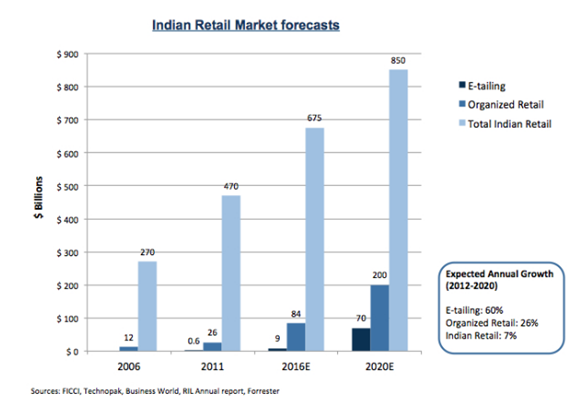
The online retail market in India may grow to 70 billion rupees ($1.33 billion) by 2015 from 20 billion rupees in 2011 as Internet access improves, according to a July survey by the Associated Chambers of Commerce and Industry of India. The FICCI (federation of Indian chamber of commerce anticipates that e- tailing in India will grow up to 84 billion rupees ($ 2 billion) (Appendix 1)
The government wants to boost the number of broadband connections more than 10-fold to 175 million by 2017, and 600 million by 2020, according to the draft of a proposed new telecommunications policy released in October 2011.
Statistics for Ecommerce in India
Indian e-commerce market hosted US$3 billion of transactions in 2011 (Source: IAMAI)
It is forecast that more than US$20 billion worth of transactions will be carried out online over next five to seven years in India and 12-15% of the country’s shopping activities will move online. (Source: IAMAI)
A total of 9 million Indian internet users carried out online transactions in 2011. This number is predicted to reach 38 million by 2015. (Source: Avendus)
India’s B2C market is expected to grow at a CAGR of 34.2% between now and 2015 (Source: Emarketer)
Online retail sales will reach US$2.4 billion (excluding online travel) in 2012, with the number of online buyers in the country expanding to 21.5 million (Source: Emarketer)
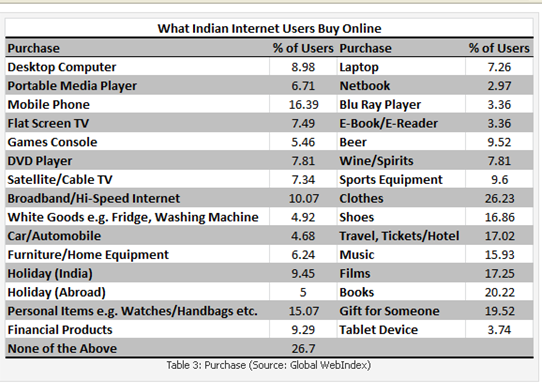
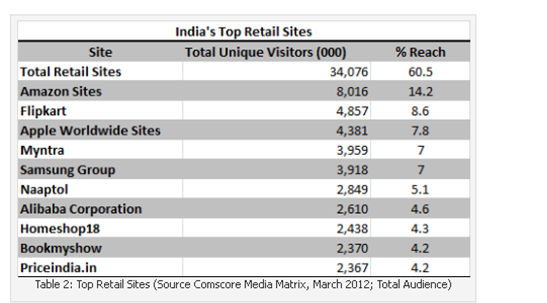
In November 2011, approximately 60% on Indian online users visited retail sites, with 7.6 million and 7.1 million users visiting coupon and consumer electronics sites respectively (Source: Comscore)
Acquisitions:
1. We read acquisition: Flipkart acquired social book discovery tool we read from Lulu US based on demand publishing firm
2. Chapak.com: Company has acquired Bollywood content site Chapak.com in November 2011 which offers news, photos, updates and videos.
3. Mime 360: Flipkart acquires Mime 360 in October 2011which is having digital distribution rights for saregama, universal music and Inreco. Mime360 delivers music content to publishers like Gaana.com (Indiatimes), My Music and iMusti, but it also allows for distribution of video (TV and Films), Games and Music. According to Binny Bansal “We’ve acquired them for the team, because they’re strong in both business and technology. That is coupled with their strong domain knowledge, because they’ve been at it for the last two years. They have strong relationships (in the music business). The digital distribution platform that they’ve built helps us with the time to market.” It’s a 100% acquisition, and a part-stock, part-cash deal. Mime CEO Sameer Nigam was asked to head digital distribution division3
4. Lets buy: In February 2012 Flipkart acquires letsbuy which is the strongest competitor in e-tailing business. It has 2 million unique visitors and over 5 million visitors every month and among the top 4 ecommerce sites in the country. Lets buy is having the revenue $150 million and acquisition is part cash and part equity. The acquisition is worth $25 million4. In an announcement company said “With this move, Flipkart has firmly established itself as the leader in the consumer electronic space. This deal will also allow for a faster rate of expansion for both companies — giving the combined entity a much larger share in the consumer electronics market,”5
5. Myntra: Flipkart acquired fashion retailer Myntra in May 2014. This will bring the synergy between two retailers. Flipkart can leverage its general merchandise capabilities to Myntra and further can sell Myntra merchandise on their portal. (http://timesofindia.indiatimes.com/tech/tech-news/Flipkart-acquires-Myntra/articleshow/35472797.cms)
Payment Mechanism:
Cash On Delivery Model (COD)
Chinese influence: When the Bansal wanted to start e- commerce site in India they compared the US e-commerce model and Chinese E- commerce model. Internet penetration in China was low as in India. Chinese e- commerce companies used cash on delivery models to penetrate into the Chinese market. Bansal thought that it is better to work with Chinese models than Amazon models. In an interview to live mint paper Bansal recalled “We looked at how Chinese companies—where e-commerce is huge—did retail online. The US has an established credit card culture, while China (like India) is a cash-based economy with lesser credit card penetration. So looking at e-commerce models in China, we put in place a cash-on-delivery system.”
The results are very encouraging for the company. Even the people from smaller cities started ordering the products online.
EMI (Equated Monthly Installments):
Many Indian customers do not have huge money left after their monthly expenditure. This has been an inhibiting factor for durable marketers. This obstacle can be overcome only by providing equated monthly installments to customers. The biggest problem of this facility is that only a few finance institutions are providing such facility, Indian central banks don’t allow retailers directly involved in finance business and customers may turn out to be bad debtors. Yet Flipkart has begun their EMI schemes on selected merchandise in association with HDFC, Citibank, Axis and ICICI bank.
Debit and credit card payments:
Security is the major reason why Indian consumers are not paying online. Government and online retailers need to educate them regarding payment security. Unlike the USA, Indians are reluctant to buy credit cards. Thus flipkart has to give COD for a time being. Slowly it can encourage customers to pay through debit card. Once the confidence is built they can think of asking the customers to pay through credit cards.
Flipkart wallet:
Flipkart has added wallet feature (storing money in the online account using debit card or credit card or net banking) to its registered members. These members now can park Rs 10,000 ($2000) in their wallet and can be redeemed for any further purchase (Appendix 2). Flipkart allows users to make payments partially using wallet and using debit card, credit card or net banking if they run out of money in their wallet but cash on delivery option cannot be used with wallet.
Supply Chain Management woes.
In the primitive stages of the evolution, companies used to depend on the courier services to deliver the books to customers in three to four days.
Courier boys’ problem: In India courier boys are trained to deliver the goods only. They lack the knowledge of cash on delivery. Most of the courier boys are less educated and don’t have a proficiency in English. Even many courier companies are not aware about Cash on delivery methods.
Courier charges: Flipkart though now they have their own courier arm but it is not reaching all the places of India. To other places than Flipkart Logistics Company has to depend on third party courier services. They charge huge money to courier the items.
Small order size: Many Customers wanted to buy on the internet for the first time. Lottery frauds and hacking news on the internet made them very cautious. They wanted to check the credibility of Flipkart. Therefore they ordered books and other products worth less than $6 (Rs 300). Flipkart had a difficult task. They have to sell the products with a large discount on MRP (Maximum Retail Price) and to ship the products free of cost to the customer. Otherwise the customer felt that he is not getting any value from Flipkart. Courier charges are mounting pressure on Flipkart for smaller SKUs (Stock Keeping units). Company decided to charge the consumers 66 cents (Rs 30) for shipping orders less than$6 (Rs 300).
Reverse logistics: few customers who ordered the products with Flipkart are changing their mind at the last minute and don’t take the order. This has created headaches for the firm. “We face significant challenges in reverse logistics. It's a big task to track unsuccessful orders, which are quite costly to manage,” Mr. Binny COO Flipkart recalls.
Buying: According to Forbes India magazine July 2012, Flipkart is buying all the products of book distributor catalogue. Some of these books were not sold for years.
Return: The buying spree has put a lot of pressure on inventory. Company is attempting to return 30-40% books to publishers whereas the industry norm is 15%. Even the categories like mobile phones face similar problems.
Suppliers’ problem in the beginning: When Flipkart started their business many suppliers were not understanding e- commerce business and they were not ready to supply the merchandise.
Budget problems: when Flipkart started they do not have enough money to start promotion aggressively. “In fact, in the initial days when we did not have a marketing budget we relied on viral and social marketing to spread the word about our services. It is only this year that we have launched traditional ad campaigns in order to reach out to more offline customers and also address existing concerns related to online shopping” Mr. Sachin Bansal recalls7.
Payment problems: Flipkart bought many products by anticipating huge sales. These distributors are asking for the delayed payment. Company is giving the reason for financial software upgradation but it is bringing discontent among the distributors8.
Order frequency: Flipkart ships 20 units per minute with 65% of purchase are made through cash on delivery mode. Such frequent order management requires coordination among marketing, distribution center and transportation.
Distribution centers: Flipkart currently have five distribution centers in Bangalore, Chennai, Delhi, Kolkata and Mumbai. It is planning to expand into other places. With robust growth in the sales the question arises how many distribution centers in the seventh largest country on the earth
Digital distribution strategy: Flipkart wallet feature helps them online payment and improve their cost9. The question is how many Indians would like to exercise payment on the internet? Why should a customer park the money in the wallet when the company is having Cash on delivery mode that gives 2-3 days time before shipping to the consumer.
Flipkart self delivery: a courier business10. To overcome the courier boys and Courier Company, Flipkart started their own courier service company. 27 cities in India are now covered with Flipkart courier. This expansion has substantially increased the employee count. In the high growth industry there's a chance of growth of employees but there should be control on head count. otherwise it will increase the employee cost. Company has to think having its own courier company and not giving third party services with it is a right model for a country like India?
I tune models; Today India is witnessing unprecedented pirate music problems. People in India do not want to buy the music as many of them are available for free. One of the reasons for piracy in the market is there is no easy option for consumers to buy music CDs and DVDs. Even if a consumer is not interested in all the songs in the album he was forced to buy the entire album which he is not. If any company offers a single song download at an affordable price people may buy the original track. Flipkart saw this is happening with Apple i-tune and wanted to replicate the same in India11.
Digital store Flyte: Aftermath of acquisition of Letsbuy, Flipkart has started a digital store called flyte in February 2012 to answer the competition of Amazon’s jungle.com. Flyte offers browse by language options where users can download international as well as regional songs. Flipkart has listed the music based on its genre on the new music store and has given a lot of variety. Customers can shop for tracks from various albums starting at Rs 6 ( 13 cents)on the store The acquisition of chapak.com and Mime 360 helped the company to offer a wide variety of music of Bollywood ( Indian Hindi cinema space similar to Hollywood).
Problems of Mime360: After the acquisition of MIME 360 which is a media content delivery platform that streams media files to publisher’s end users Flipkart has to separate the business of it’s with MIME 360 as acquire offers delivery services to competitors like hungama.com and gaana.com. Though Mr. Sachin Bansal ruled out any conflict with Mime offering service to competitors on the grounds of user interface and search options but if a customer offered the same content across the three websites he may opt for Flipkart and Mime may lose the business of gaan and Hungama.com.
Subscription Model or digital download: Till this case was finalized Flipkart did not have subscription of books to build online libraries. Negotiations with suppliers were on. Company is not clear looking at the customer whether to offer library subscription of digital e- book download to customer. The country is witnessing pirated book stores on the internet and many publishers may not want to share their e- books.
Consignment model versus warehouse model:
In the consignment model, adopted in the beginning, Flipkart used to get the products ordered by the customer only after the customer completed the order management. This was helping the company to reduce the inventory. Now, Flipkart has migrated to a warehouse model. The company has warehouses at different locations and with large inventory they can reach the consumer more quickly. Mr. Sachin Bansal is of the opinion that it provides the control over the logistics12.
No self publication:
Unlike the major e- commerce retailers, Flipkart is not having its own publication. It depends on the third party publishers to supply the books.
Entry of Google play in the gaming: Search engine giant Google entered with Google Play in India. Will Flipkart be able to withstand the competition from Google is the big question. This will exert pressure on their gaming category
Less penetration of e- books: India is not still ready for e- books. People still read the hardcopy of the book. Hence the company loses the chance of selling e- books and reducing overall cost. The hard copy of the book increases the cost to the company.
Pirated books and music: Most Indians who have internet connection are used to download the music through torrents or free websites. The paid form of music will work is a big question. If a company brings e- books there is no guarantee that these books are circulated without permissions. Even the Indian legislations on copyright are not so strict like western countries.
Heavy discounts by competitors:
Flipkart in the beginning hadn’t had big competition. The entry of bookadda, indiatimes shopping, e- bay, Junglee and many more put pressure on it. These competitors started offering discounts 40% and more. For instance Gregory David Roberts’ shantaram is for Rs 419($8.4) on the Flipkart whereas it is available for Rs 397($7.5) on bookadda and Rs 406($8) on another competitor Infibeam 13.
Human resources: Many of the members in the management team are from IIT Delhi. In the Forbes India magazine July 2012 issue one of the ex- employees expressed displeasure about this. The magazine further reported that founders wish to have a close circle and don’t want to disclose their information. Even they ruled out getting consultancy from IIM with fear of information breach. (Appendix 6)
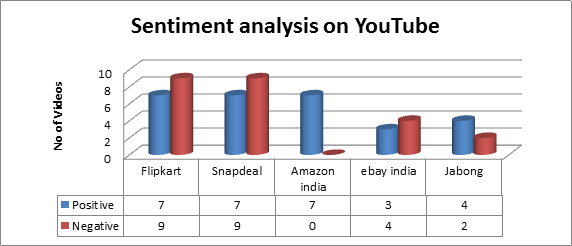
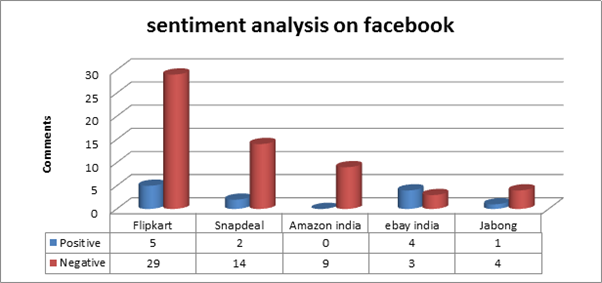
Internal Supply chain problems: Aftermath October 6 2014 the big billion day, the technology in capabilities of Flipkart is exhibited in the open. Flipkart could not hold the huge traffic on the promotion day. The site crashed, an error message was coming frequently on the user page, price jacking was noticed and more than that company script was changed abruptly. This has resulted in the negative sentiment in the market.. The text clouding and sentiment for the big billion day was given in the appendix 7
Future plans:
Company wants to have both organic and inorganic growth. In an interview with Techiris Mr. Sachin Bansal said about his future plan as “As far as future is concerned, we will be looking at bigger investments in our supply chain and technology. In terms of sales we were earlier looking at a figure of $1bn by 2015. But we feel that we can achieve this in the next two to three years. We will also be looking at entering new categories. Additionally, Flipkart Self-Delivery, which currently operates in 27 cities, will be further scaled up”. Company wants to provide a complete e- shopping experience to Indian consumers. It wants to scale up the number of categories now offered. They also have plans to expand the business to other countries once they consolidate their position.
Appendix 1:
Appendix 2:
Appendix 3:
Appendix 4: Financial facts of Flipkart
(Source: Binny Bansal | the flip side of an e-venture Livemint May 26 2011)
( **Source; can Flipkart deliver, Forbes India July 2012)
Appendix 5: Product categories in Flipkart
(Accessed from www. Flipkart.com on 10/10/2012)
Appendix 6: Management team

(Source; Can Flipkart Deliver, Forbes India July 6 2012)
Appendix 7: Sentiment analysis towards online retailers on big billion day ( Dr. Joel and Prof. Prasad)
Bibliography

1. http://www.telegraphindia.com/1100228/jsp/graphiti/story_12157168.jsp
2. Binny Bansal | the flip side of an e-venture , Livemint May 26 2011
3. http://www.medianama.com/2011/10/223-flipkart-mime360-digital-music-ebooks-games
4. http://www.medianama.com/2012/02/223-flipkart-letsbuy/.
5. http://www.business-standard.com/india/news/flipkart-buys-letsbuy-incash-equity-deal/464289//
6. http://www.pluggd.in/accel-india-invests-in-flipkart-297/
7. http://thetechiris.com/541/how-flipkart-helped-india-realise-its-e-commerce-dream/
8. Can Flipkart Deliver, Forbes India July 6 2012
9. http://www.medianama.com/2011/11/223-flipkart-adds-online-wallet-to-ease-payment-woes/
10. http://thetechiris.com/541/how-flipkart-helped-india-realise-its-e-commerce-dream/
11. http://www.medianama.com/2011/10/223-mime360-flipkart/
12. The Flipkart story, The Hindu April 7 2012
13. Flipkart faces the heat of rivals’ discount 7th May 2012 Times of India.
14. Inside flipkart's complex structure. (2014, Nov 25). Mint Retrieved from http://search.proquest.com/docview/1627647811?accountid=131540.
15. Thoppil, D. A. (2014, Jul 30). WSJ.D technology: Flipkart's $1 billion war chest --Indian E-commerce pioneer taps investors as it girds for amazon. Wall Street Journal Retrieved from http://search.proquest.com/docview/1549097501?accountid=131540
16. Flipkart.com launches aIn-a-day guaranteea delivery. (2013, Dec 10). India Digital Review, Retrieved from http://search.proquest.com/docview/1518533386?accountid=131540


