Thursday, July 7, 2022


Monday, March 21, 2022
Hypertargeting and the Banana Curve: Reconsidering Precision in Digital Marketing
Hypertargeting and the Banana Curve: Reconsidering Precision in Digital Marketing
Author: Dr. Prasad Kulkarni
Location: India
Date: March 19, 2026
TL;DR
Hypertargeting improves marketing outcomes only up to a threshold. Beyond that point, captured by the banana curve, excessive personalization can reduce trust and weaken long-term engagement.
Meta Description
A critical analysis of hypertargeting and the banana curve, explaining how excessive personalization can reduce marketing effectiveness and reshape consumer trust in digital environments.
Highlights
Hypertargeting increases relevance but only up to a shifting threshold shaped by context and perception.
The banana curve captures the non-linear relationship between targeting intensity and effectiveness.
Excessive personalization may induce discomfort, weakening trust and long-term engagement.
Strategic recalibration, rather than abandonment, appears more defensible in uncertain environments.
Definition
Hypertargeting refers to the use of granular consumer data to deliver highly personalized marketing messages.
The banana curve describes how marketing effectiveness increases and then declines as targeting becomes too precise.
What is hypertargeting and how does the banana curve reinterpret its value?
What is hypertargeting?
Hypertargeting is a digital marketing strategy that uses detailed consumer data to deliver personalized ads to specific individuals. It extends beyond traditional segmentation, relying on algorithmic inference rather than broad categories. The appeal lies in its promise of precision. Yet, this promise is conditional.
What is the banana curve in marketing?
The banana curve in marketing explains why too much personalization can reduce effectiveness. Initially, relevance improves. Consumers encounter messages aligned with their needs. Over time, however, excessive specificity alters perception. Messages begin to feel intrusive rather than useful.
This reinterpretation unsettles linear assumptions about data-driven marketing. Empirical evidence suggests that personalization improves engagement within limits (Bleier & Eisenbeiss, 2015). Those limits, however, are neither stable nor easily observable.

Why does hypertargeting sometimes reduce marketing effectiveness?
Why can personalized ads feel intrusive?
Personalized ads feel intrusive when consumers believe their data is being overused or monitored too closely. This perception introduces discomfort. It may not always be visible in immediate metrics.
The “personalization paradox” illustrates this tension. Tailored messaging enhances relevance while simultaneously raising privacy concerns (Aguirre et al., 2015). Cognitive evaluation and emotional response do not always align. This creates interpretive uncertainty.
Why does trust decline with excessive targeting?
Trust declines when consumers perceive a loss of control over their personal data. Hypertargeting can expose the asymmetry between data collection and user awareness. The result is subtle. Engagement may persist. Confidence may not.
Where does the banana curve appear in practice?
Where is hypertargeting most effective?
Hypertargeting works best in early stages when personalization improves relevance without crossing privacy boundaries. This often occurs in initial interactions or when intent signals are recent.
Where does over-targeting become a problem?
Over-targeting becomes a problem when ads follow users repeatedly across platforms without contextual relevance. Retargeting campaigns illustrate this pattern. When frequency exceeds usefulness, effectiveness declines.
Research indicates that timing and specificity determine retargeting outcomes (Lambrecht & Tucker, 2013). The banana curve emerges across platforms rather than within a single channel.
How can marketers identify the inflection point?
How do you know when hypertargeting is too much?
Hypertargeting is too much when engagement stabilizes but user sentiment begins to deteriorate. This is difficult to detect using conventional metrics.
Observable indicators such as click-through rates provide partial insight. They do not capture latent discomfort. The inflection point is therefore probabilistic. It shifts across users and contexts.
How do algorithms handle this threshold?
Algorithms attempt to optimize targeting continuously, but they often lack interpretability. They detect performance changes without explaining them. This creates a strategic blind spot.
Why does the banana curve matter for long-term strategy?
Why should marketers care about the banana curve?
Marketers should care because excessive targeting can harm long-term customer relationships. Short-term efficiency may obscure long-term costs.
Privacy regulation further complicates this dynamic. Restrictions on data usage influence advertising effectiveness (Goldfarb & Tucker, 2011). The banana curve thus intersects with both behavioral and regulatory domains.
What conceptual critique emerges from hypertargeting?
What are the limitations of hypertargeting?
Hypertargeting assumes that consumer preferences are stable and fully measurable through data. This assumption is contestable. Preferences are often fluid and context-dependent.
What happens when exposure becomes too narrow?
When exposure is too narrow, consumers may not discover new preferences or alternatives. Hypertargeting may inadvertently constrain choice architecture. The banana curve then reflects not only declining effectiveness but also reduced experiential diversity.
Conclusion
Hypertargeting remains influential. Its utility, however, is conditional. The banana curve introduces a necessary hesitation into claims of precision. It suggests that effectiveness is not simply a function of more data. Instead, it depends on how that data is perceived, interpreted, and integrated into consumer experience. The curve bends. Its curvature is neither fixed nor fully predictable. That uncertainty, rather than being a limitation, may be analytically productive.
References
Aguirre, E., Mahr, D., Grewal, D., de Ruyter, K., & Wetzels, M. (2015). Unraveling the personalization paradox: The effect of information collection and trust-building strategies on online advertisement effectiveness. Journal of Retailing, 91(1), 34–49. https://doi.org/10.1016/j.jretai.2014.09.005
Bleier, A., & Eisenbeiss, M. (2015). Personalized online advertising effectiveness: The interplay of what, when, and where. Marketing Science, 34(5), 669–688. https://doi.org/10.1287/mksc.2015.0930
Goldfarb, A., & Tucker, C. (2011). Privacy regulation and online advertising. Management Science, 57(1), 57–71. https://doi.org/10.1287/mnsc.1100.1246
Lambrecht, A., & Tucker, C. (2013). When does retargeting work? Information specificity in online advertising. Journal of Marketing Research, 50(5), 561–576. https://doi.org/10.1509/jmr.11.0503
Sunday, October 17, 2021
Agile fundamental- Goals of SCRUM master
Goals of SCRUM Master
- Transparency in creating story maps.
- Transparency in updating confluence pages with retrospective ideas.
- Coach the scrum team on tracking down the work.
- Coach on developing outcomes, reviews, and measures.
- Adopt delegation poker to self organize in the development team.
- Scrum master defines the values from 5 perspectives. They are a) Courage, b) focus, c) commitment, d) respect, and e) openness.
- SCRUM master helps product owners in sprint planning and sprint review. SCRUM master helps the development team in daily stand ups.
Tuesday, October 5, 2021
Agile Marketing fundamentals III: Product Backlog

Product Backlog
Product backlog is the prioritized list of features used for product development.
Product backlog goals:
Creation of user stories.
Flexibility to adapt to new needs and realities.
Collaborated platform for product release.
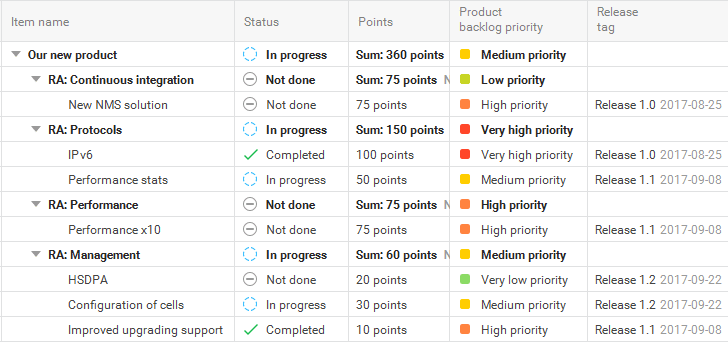
Product backlog items:
Features
These new features emerge from the sales team, operation employees,
customers, intermediaries, customer service team and so on.
Prioritizing new features have hurdles such as keeping existing customers
happy, creating the lead for future sales, and striving
hard to attain company vision.
The onus is on the product manager to resolve any
issues pertaining to prioritization.
Technical debt
Reducing maintenance costs.
Making infrastructure change in case of manufacturing concerns and
architectural changes in case of information technology companies.
These are called technical debt due to its impact on the long term goals.
Bugs/ customer problems
These are identified by the customer while using the product.
Research
Company has a little information about new features.
Research results in better user stories or spikes.
Product backlog team
Team member: works on the user stories created by the agile team.
Product owner:inspecting progression of new features and refining.
Project manager: Product development and the progres.
Stakeholders: working on the schedule and looking for the final product.
Initiatives
These are a set of epic is aiming towards attaining the goal specified. It works based
on cross functional teams and sometimes on matrix structures.
Example; Develop a new smart phone with foldable design, AI tools, and 5G technology.
Epics
The method of dividing the large work into small tasks.:
Example : collection of stories is called epics.
Smartphone foldable design.
Smartphones built with the feature of AI based marketing tools.
Smartphone with 5G feature.
Stories
These are called ‘user stories'. It is the requirement plan from the customer's perspective.
Examples:
Google meet need attendance feature built in rather than as add on.
Smartphones built with the feature of AI based marketing tools.
Foldable helmets for ladies.
Additive manufacturing for casting.
Two Rs of the product backlog
Road map development
Product backlog refinement
The Sprint team prepares the detailed estimate description.
Sprint team assures the ‘ready’ position
Ready position can be achieved before the sprint meeting or it may be just in time.
Refinement activities begin before the sprint meeting and continue later.
Refinement can be done by the product owner or development team.
Advantages of product backlogs
It guides the team towards attaining the goal.
Unlike the waterfall model agile team can begin working on ideas rather
than product backlog.
Team can remove product backlog items at any time of the process.
It reduces the time and avoids unnecessary discussion on the product.
Disadvantages of product backlog
Many time product backlog is not enough. Customer interactions provides more information.
There is no guarantee of product delivery.
Product backlog can stop the process at any stage.
Product Backlog development
|
User stories |
Story points |
Priority |
|
|
High priority |
The smartphone is having 5G feature so that i can browse faster |
4 |
1 |
|
The smartphone is in the regional languages |
3 |
2 |
|
|
The smart phone can be folded |
3 |
3 |
|
|
Low priority |
The smartphone is having CDP for AI tools |
4 |
4 |
Product backlog prioritization
This is the responsibility of the product owner.
High prioritization items have the options for refinement and have a
high value to the organization.
Middle prioritization items will become candidates for prioritization.
Low prioritization items can be ignored till it archives the candidate of middle prioritization.
Product backlog techniques
DIVE
Dependencies
Insure against risk.
Value
Estimated effort.
2. DEEP
Detailed approporities
Estimated
Emergent
Prioritized
3. INVEST
Independent
Negotiable
Valuable
Estimable
Testable
Grooming
Three principal activities of the product backlog are called grooming.
Creating and refining product backlogs.
Estimating product backlogs
Prioritizing product backlogs.
Grooming is the responsibility of the product owner.
Analytic product backlog items
References
VII, P. (2016). Agile Product Management: Product Backlog:
21 Tips To Capture and Manage Requirements with Scrum. (n.p.):
CreateSpace Independent Publishing Platform.
Rubin, K. S. (2012). Essential Scrum:
A Practical Guide to the Most Popular Agile Process. United Kingdom: Addison-Wesley.
Alt-Simmons, R. (2015).
Agile by Design: An Implementation Guide to Analytic Lifecycle Management.
United Kingdom: Wiley.
Sutherland, J., Coplien, J. O. (2019).
A Scrum Book: The Spirit of the Game. (n.p.): Pragmatic Bookshelf.
Single Reference Guide for Scrum Certification:
Professional Scrum Master I (PSM I) and Professional Scrum Product Owner I (PSPO I)
Certification. (2020). (n.p.): Vishal Malhotra.
Mir, R. C. (2020).
Iterative Business Model Canvas Development - From Vision to Product Backlog:
Agile Development of Products and Business Models. Germany: BoD - Books on Demand.
Jocham, R., McGreal, D. (2018). The Professional
Product Owner: Leveraging Scrum as a Competitive Advantage.
United Kingdom: Pearson Education.