Friday, January 1, 2021


Monday, December 14, 2020
Monday, December 7, 2020
Green Bonds in India
Green Bonds in India
What are green bonds?
Green bonds are debt securities issued by financial, non financial and Public sector undertakings. The resource will be used for 100% green projects and assets.
What are green projects?
1. Renewable energy
2. water and energy efficiency
3. Bio energy
4. Low carbon transports. ( Down-to-earth 2020)
Introduction
India is the second largest green bond market in the world( ET energy world, 2020)
Indian companies involved in green bond market
1. Indian renewable energy development agency((IREDA) 2018
2. Indian Railway finance corporat5ion 2018
3. State Bank of India 2020 100 Million(Ghosh, 2020)
Features of green bonds in India
1. Coupon rate: Fixed
2. tenure: 6 months to 30 years.

References:
1. India becomes second-largest market for Green Bonds with $10.3 billion transactions - ET EnergyWorld. (2020). Retrieved 7 December 2020, from https://energy.economictimes.indiatimes.com/news/renewable/india-becomes-second-largest-market-for-2. green-bonds-with-10-3-billion-transactions/73898149
Green bonds: Is it green finance or green-washing?. (2020). Retrieved 7 December 2020, from https://www.downtoearth.org.in/blog/energy/green-bonds-is-it-green-finance-or-green-washing--72755
3.
Ghosh, S. (2020). State Bank of India raises $100 million in green bonds. Retrieved 7 December 2020, from https://www.livemint.com/companies/news/state-bank-of-india-raises-100-million-in-green-bonds-11585408209737.html
Saturday, December 5, 2020
Marketing 5.0 and marketing clouds.
Marketing 5.0
Intelligent systems will redefine marketing in the future. Artificial intelligence systems will be used as both production and representative systems (Dragnov. M, 2018). Further, these AI systems will automate marketing and email marketing. It will work on dynamic pricing. Added to this, voice support and chat box have a greater role in marketing 5.0. (LinkedIn,2019)
Marketing clouds
Marketing cloud is an integration of social media, consumer profiles, audience management and analytics.
Functions of marketing clouds:
- They track customer journey on the web.
- They send personalized messages to customers.
- They enhance content delivery mechanisms.
- They help in nurturing the leads.
- Thy do content forecasting.
- They manage social campaigns.
- They help company to moentize their experience.
- They identify audience segments among the profile lists.
- They optimize marketing solutions.
- They collect data from multiple sources
Top 10 Companies in Marketing cloud operations.
- Adobe Marketing cloud.
- Salesforce.
- SAP
- IBM
- Orcale
- Hub spot.
- Experian.
- Agile one
- Sailthru
- Marketo
Marketing 4.0 built upon mobile technology and power of social media. In a similar way marketing 5.0 will be built on customer engagement. The main emphasis is providing omni-channel experience to customers by clubbing marketing 4.0 channels and emerging platforms.(Ellet , 2020)
References
- Draganov, M., Panicharova, M., & Madzhirova, N. (2018, June). Marketing 5.0. Transactions of Artificial Intelligence Systems in The Digital Environment. In 2018 International Conference on High Technology for Sustainable Development (HiTech) (pp. 1-3). IEEE.
Ellett, J. (2020). Technology Is Changing The Future Of Marketing (Again). Retrieved 5 December 2020, from https://www.forbes.com/sites/johnellett/2014/09/30/technology-is-changing-the-future-of-marketing-again/?sh=2172175ce7df
Marketing 5.0: A View to Marketing in the 2020s and Beyond. (2019). Retrieved 5 December 2020, from https://www.linkedin.com/pulse/marketing-50-view-2020s-beyond-erik-newton/
Wednesday, November 18, 2020
Wednesday, November 11, 2020
Tuesday, November 3, 2020
Wednesday, October 21, 2020
Saturday, October 3, 2020
Discounts and allowances.
Discounts and allowances.
Price reductions in the distribution channel either at manufacturer , a retailer or a buyer level for paying the bill promptly is called discount.
Level of discounts:
Manufacturer level: Manufacturer provides price reduction on the list price printed on the package.
Retailer level: A retailer offers price reductions on Maximum retail Price(MRP). D-mart, a retail store offers 10% off on selected merchandise in its stores.
Buyer level: Discounts offered to customers for paying through credit cards, company loyalty cards, or discount coupons.
Objectives of Discounting
Sales executives offer discounts to close sales in a supply chain. Similarly, companies with over capacity discount products for immediate sales. In addition to this, discounting offered to clear the sales in the supply chain. Additionally, discounting is used as a motivational tool for distribution channels members performing excellently. Apart from this, discounting is a reward mechanism for customers who buy large quantities or buy regularly or buy through new payment systems. Lastly, discounting attracts customers to buy more products of a manufacturer.
Discount types
Payment discounts
i) Trade discounts; Discounts offered by a wholesaler, stockists, distributor or a manufacturer to retailer at the list price
2/10 net 30 rule: A company manufactures Ragi malt and sells it to a distributor worth say Rs 1 lakh on 1st january 2021. The distributor is having 30days time to clear the bill of the manufacturer. If the distributor makes payment within 10 days i.1. 10 january 2021, a manufacturer offers 2% discount i.e. Rs 2000 on Rs 1 lakh.
3/7 EOM: A distributor sells Jeer Soda to a retailer on 15th February 2021. He raised an invoice on 25th February 2021 and asked the retailer to pay by 7th March 2021. After this, if a retailer pays an amount within 7days from 15th February 2021 3% discounts will be offered.
3/7 EOM net 30: Unlike 3/7 EOM, this method has a 30 days time on invoice date for time. If an intermediary pay the bill within 7 days from the invoice date will get a 3% discount.
2/15 net 40 ROG: A stockist of cotton sarees sends goods to a retailer on say 1st March 2021 and provides time till 9th April for payments(40 days). If the retailer pays the amount by 15th march( 15 days) the stockist will offer 2% discounts.
ii. Cash discounts: The discount offered by intermediaries to customers for paying bills, through cash, It avoids credit cards due to payment charges.
iii. Partial payment discount: A wholesaler of lamp oil provides Rs 1 lakh worth of oil and provides 30 days credit time. A wholesaler also offers a 2% discount to the retailer who pays within 10 days. However, a retailer pays only 50% of payments within 10 days and the wholesaler offers 1% discount.
iv. Sliding scale: The discount offered to charitable organizations or economically poor customers by supply chain members of the organization.
v. Seasonal discount: Discounts given in a slack period. A Jaljeera manufacturer offers discounts in the winter to increase sales.
Supply chain Discounts.
i. Performance discounts; Discounts offered by a company to its wholesaler for sti-ocking , shipping or shelving. The rule 20/12/5/ says that 20% discount for warehousing, 15% for shipment, and 5% discount on shelving.
ii. Trade in credit discounts: manufacturer sells 3G mobile handsets to retailers. However, a retailer could not sell 3G handsets. These retailers return the product to the manufacturer. Here, manufacturers may sell this on ecommerce or at refurbishment market, For these performances a company offers discounts to retailers.
Quantity discounts; Encouraging trade partners to buy more products such as a company can reduce the price via economies of scale.
i. Cumulative quantity discounts: A manufacturer of kerosene stoves offers 5% discount on purchase of 100 stoves in a month. Now a retailer purchases 60 stoves on 10th of March and another 60 stoves on 25th of march. Both orders do not have required order quantities of 100 to avail discount. However, a retailer;s cumulative purchase is 120 stoves and eligible for discount.
ii. Non cumulative quantity discounts; In this quantity discounts, a manufacturer provides a discount for a single large order in a particular time period.
Characteristics discounts
Disability discounts: People with differently abled get discounts on a product. For example karnataka State road transport corporation(KSRTC) offers bus passes with concession to differently abled people.
Student discount: Personal computer companies offer extra discounts to students.
Professional discounts: organizations offering extra discounts teachers, doctors, government servants and lawyers. Indian overseas banks offer special interest for teachers.
Employee discount: Organizations offering extra discounts to its employees. Bigbazaar offers extra discounts to its employees as an example.
Army employee discounts: Defence personnel availing extra discounts at defence canteen stores.
Age discounts: A few organizations offer extra discounts to senior citizens, For example Apollo pharmacy offers 5% extra discount to senior citizens.
Social discounts: A special discount to friends, colleagues, school mates or neighbours of a particular location.
Allowances:
These are usually paid to supply chain members for promoting the company's products and services. Further, allowances are also paid for faulty products.
Rebates: company allows price reduction through coupons, receipts or barcodes.
Coupons; a voucher given by a customer to get discounts while purchasing a product.
Promotional allowances; A manufacturer provides promotional allowance to a retailer to conduct local promotions. Nagashanti Motors gets allowances for promoting Hero motocorp bikes in Belagavi.
Thursday, September 10, 2020
Case study: Reliance Jio and Facebook deal: A death bell to competitors?
Reliance Jio and Facebook deal: A death bell to competitors?
On April 17 2020, Reliance head office is in a celebration mood when Mr. Mukesh Ambani announced the plan of Facebook buying 9.96% largest minority stake in Jio for Rs 43, s74 crores. This was the largest investment in the It sector in India. The entire deal is cash based.
Jio Platforms
Jio platforms is the part of Indian conglomerate reliance industry. It started offering services in 2019. During this time $15 billion debt of Jio Platform to the reliance industry to have control over the Jio Platform. In march 2020 Silver like and Mubadala invested money in the jio platforms. In june 2020 PIF and Intel also acquired a minority stake in the Reliance Jio platforms. Google acquired 7.7% of stake in teh Jio Platforms.
Jio platform is the parent body of Jio phones, jio mart, Jio Cinema, and Jio saavn. The deal will give an observer role and Board seat on Jio platform to Facebook. Jio Mobiles is having reach of 38 crore people in India
Jio apps included MyJio, JioTV, live TV streaming app, launched on 5 September 2016, JioCinema, video-on-demand app, JioSaavn, an online music streaming service, JioChat, messaging app, JioMeet, video-conferencing platform, JioBrowser, web browser, JioSwitch, file sharing app, JioNews, newspaper and magazine app, JioHome, mobile remote control for Jio set-top box, JioGate, apartment security app, JioCloud, cloud storage services, JioSecurity, security app, JioHealthHub, health companion, JioPOS Lite, Jio recharge commission earning app, JioGameslite, online gaming, JioMoney, digital currency and payments services and JioMart, online grocery delivery services. Jio valuation has touched 5.5 trillion dollars in May 2020 making it the largest business houses of reliance industries.

( Source: Company annual reports)
Reliance retail
Reliance retail is the sixth largest retailer in the world. The retail company added 10 stores every day in the last two years and it has 10000 stores. The company has more stores than any other competitor in india. The company has seen 5 crore Indians visiting its stores in 2019 and registered a mind blowing 44% growth. The reliance retail physical presence is now expanded to 6700 cities in india. This resulted in a huge employment generation. In 2020 the company employed 1,13,000 employees. Further the company revenue touched 1,30,566 crores in 2018-19 fiscal year.
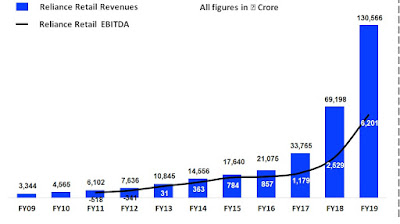
(Source: Reliance annual reports)
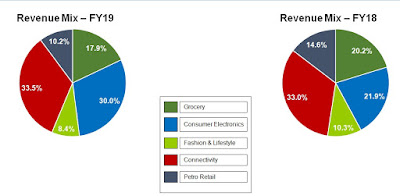
The reliance retail company revenue comes from five different categories. The connectivity(33%) is the largest contributor to the revenue followed by consumer electronics(30%), Grocery(17%), Petro retail(10%) and fashion (8%)
Facebook and WhatsApp
Facebook idea generated when Mark Zukerberg was studying at Harvard University in 2003. The earlier name of Facebook was facemash. This site attracted 450 visitors and 22000 photoviews in the first 4 hours of the launch. Harvard University expelled Mark zukerberg for the violation of privacy data breach. After finishing the expulsion, Zukerberg convinced Harvard university to come out with a digital version of student directory and launched The facebook site.
In 2004 the company moved its headquarters to california. Further, in May 2006 facebook was open for public view. The year 2007 gave impetus for the growth of facebook where Microsoft invested in facebook and facebook developer platform started. Facebook saw exponential growth and could achieve 500 million visitors by 2010. The year 2013 turned facebook into the search world. It launched facebook graph search. Unlike earlier versions wherein a customer used to get search links, The facebook graph search gave precise answers.The growth of facebook also led to false message proliferation. In 2015 the company came out with a Facebook algorithm that detects Fake messages. Facebook faced the backlash when major advertising companies like Adidas, Coca-cola , Ford etc.. backed out of Facebook advertisements for not acting hatred messages.
WhatsApp started by Brian Action, former employee of Yahoo in 2019. The app became a buzzword on the Apple store and the same vibes continued on Google Play store. By 2010 the company crossed the 200 million subscriber mark. In 2014 facebook acquired WhatsApp for a whopping US $19 billion. The year 2016 made WhatsApp absolutely free for the consumption from changing $1 subscription mode.
Facebook is having 33 crore Indian subscribers making this as the largest market for the company. Similarly WhatsApp is having 400 million customers in India.
Indian telecom Sector:
The Indian telecom industry is the second largest telecom sector in the world. India today has 117 crore telecom subscribers and 67 crore internet users. Teledensity in India grew to 87%. India’s data usage over the period grew exponentially. Today, every indian consumes 9GB of data per month. This made India as the country of largest data users in the world.
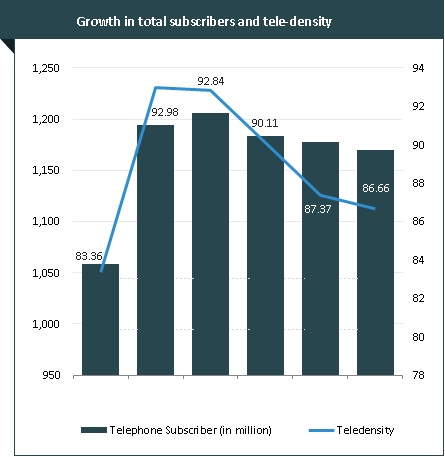
(Source: IBEF.org)
The Indian rural consumers using telephone service grew exponentially. In 2011 the rural contribution was at 33% and it grew up to 44% in 2020.
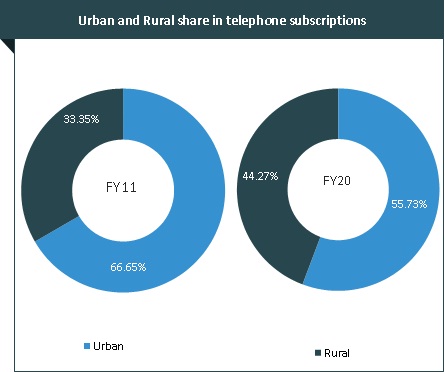
(Source: IBEF)
This sector is expected to grow further with the IoT industry emerging faster. The 5G technology may increase data usage and companies will get better revenue in the future. The Indian telecom competitive landscape is given below:
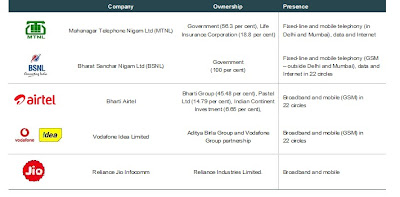
(Source; IBEF India)
Indian Retail sector
India’s retail market is one of the fastest growing retail markets in the world. It is expected to touch $1200 billion market size by 2021.
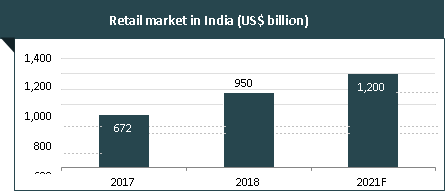
(Source: IBEF)
The fast moving consumer goods and online consumer market in India witnessing a healthy growth
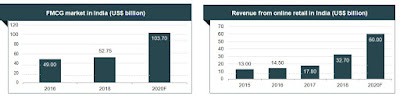
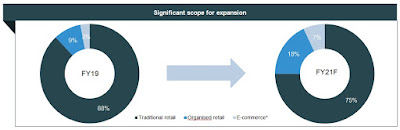
FMCG business is expected to reach US$ 103 billion by 2020 and Online retail business is expected to reach US$ 60 billion in the same year. However,India’s organized retail market is in a nascent stage. The organized retail contributes to 9% of the total market. 88% of the market is in the unorganized sector that reliance group and Facebook both are eyeing for their pie.
Cross leveraging
Jio Mart and Whatsapp will cross leverage their ecommerce platform to grow their businesses.
The deal will help many small businesses to sell their merchandise on JioMart using WhatsApp.The deal is having the target of reaching 6 crore SMEs, 12 crore farmers, 3 crore small retailers. Online grocery demand was 1% of 80000 crore rupees market before the lockdown and during the covid-19 lockdown it surged to 50%. JioMart competitors' Bigbasket business has seen tremendous demand in the lockdown but they lacked agricultural resources to supply. This facebook and Jio deal is expected to provide technology platform for small kirana stores. Further , initially the deal was thought to have obstacles from the competition commission of India. However, the commission allowed Jio platforms and Facebook to run their businesses on June 24th 2020. Apart from this, the deal will help Facebook aggressively push their WhatsApp pay through Jio platforms. In addition to this, the agreement will open the way for cryptocurrency and block chain technology of Facebook in the Indian market. The government of India allowed block chain technology. It will strengthen the facebook global business. Another plus point of this consensus between Jio and facebook is use of Augmented reality. Facebook augmented reality division Oculus will leverage its technology to Jio Ar. This is expected to redefine marketing communications. One more unnoticed thing in this agreement is advertisement sharing. Facebook ad space can be leveraged by Jio Mobile. This will redefine mobile advertising and marketing in india. The new friendship will open the doors for developing a super app like ‘we chat’ where the customer starts the day with newspaper , meetings , payments,and sports. Finally, this deal will open new vistas for indian gaming industry. Facebook can come out with games like farmville to the indian market.
Jio Mart and whatsapp business Model
The business model of WhatsApp and Jio Mart is simple and enriching. The Jio Mart provides training to Unorganized kirana store managers. They will register their Kirana store with JioMart . These Kirana store owners should use jip platform and WhatsApp to conduct the business. Now, A customer uses his Jio Mart link on the WhatsApp or Jio App directly to book orders. The message is passed to Nearby Local stores whatsApp account. The local store accepts the order. here , customers can track the order. Products are delivered to the customer location by nearest grocers. The products can be bought by Kirana store or reliance Jio Mart wholesale outlet will transport goods to Kirana stores. Payments will be made to kirana stores according to product margins.
Conflicting interests.
Managing business independently: Jio and Whatsapp will be different entities and run their businesses on existing revenue models.
Data Privacy: Customer data at both JioMart and WhatsApp can be leaked or misused. The US government has strict rules for customer data privacy. However, Indian government does not have a concrete plan for the same. Thus, Indian data can move to the USA and USA data will not come to india. This may lead to India china app issues like situation in future.
Net Neutrality: Facebook and WhatsApp and Jio can leverage each other. This may create the most discussed topic i.e Net Neutrality. Free basics may come back to India from the backdoor.
Advertisements will consume data packs of customers: Facebook ads appearing on Reliance Jio platform may result in excess consumption of data packs of customers. This is how facebook can increase their revenues.
Facebook denial of data localization: The whatsApp pay dismal performance in India and government restriction on data localization has hit a roadblock. There is no clarity on how indian consumer data can be held together. Contrary to this Reliance has agreed to share customer data of theirOver the top (OTT) market to the central government.
Supreme Court and whatsApp litigations: Though the central government gave nod for the whatsApp pay, Supreme court has stopped its commercialization as cases already pending in front of them.
Restrict data to competitors: Facebook and Jio can restrict their used data to the market . This will ring a death bell for Google and Microsoft. The minute details of customers help facebook to narrow its targeting.
New product proliferation: Both Jio and Facebook launch new products of both companies as well as their associates. Customers may find it difficult to digest.
References:
Facebook buys 9.99% stake in Reliance Jio for Rs 43,574 crore. (2020). Retrieved 9 September 2020, from https://economictimes.indiatimes.com/tech/internet/facebook-buys-9-99-stake-in-reliance-jio-for-5-7-billion/articleshow/75283735.cms#:~:text=Facebook%20will%20invest%20Rs%2043%2C574%20crore%20in%20Jio%20Platforms%2C%20a,especially%20for%20its%20WhatsApp%20unit.
TechCrunch is now a part of Verizon Media. (2020). Retrieved 9 September 2020, from https://techcrunch.com/2020/06/24/india-approves-facebooks-5-7-billion-deal-with-reliance-jio-platforms/
Explained: What the Jio deal means for Reliance and Facebook. (2020). Retrieved 9 September 2020, from https://indianexpress.com/article/explained/what-the-jio-deal-means-for-reliance-facebook-6374686/
Four Reasons Why Reliance Jio-Facebook Deal is Commercially Sensible and Good for India, Writes Subramanian Swamy. (2020). Retrieved 9 September 2020, from https://www.news18.com/news/opinion/why-reliance-jio-facebook-deal-is-commercially-sensible-and-good-for-india-subramanian-swamy-writes-2595979.html
John, C. (2020). Facebook-Jio Deal: How Is It Going to Shake Up The Indian Market?. Retrieved 9 September 2020, from https://www.thequint.com/tech-and-auto/tech-news/facebook-reliance-jio-deal-explained-how-does-it-benefit-users
Diplomat, T. (2020). The Realpolitik of the Reliance Jio-Facebook Deal. Retrieved 9 September 2020, from https://thediplomat.com/2020/04/the-realpolitik-of-the-reliance-jio-facebook-deal/
Facebook-Jio Deal: What India’s Competition Regulator Will Have to Consider. (2020). Retrieved 9 September 2020, from https://thewire.in/business/facebook-jio-deal-what-indias-competition-regulator-will-have-to-consider
Subscribe to:
Posts (Atom)